
Indo MIM: The World's Largest MIM Company
A deep dive into Indo-MIM's precision engineering business covering metal injection molding, financial track record, key risks, and what to watch after the IPO
New in Investorstack
We now have a dedicated page for IPOs where we cover all upcoming IPOs live. For each company there is an IPO note: a detailed research report about the company, with a valuation model built from the offer document so you can make sense of the valuation at which the company is coming in.
Indo-MIM manufactures precision engineering components using metal injection molding (MIM) as its core technology, supplemented by ceramic injection molding, investment casting, precision machining, and metal 3D printing. The company states it is the largest global MIM manufacturer by revenue, with a 6.8% market share in CY 2025, holding that position for six years (Source: F&S Report commissioned for the offer). In Fiscal 2026, it manufactured over 9,000 distinct product types and served more than 1,100 customers across 55 countries.
The dual-shore manufacturing model
The company operates 15 core manufacturing facilities across four countries: six in India, six in the United States, two in the United Kingdom, and one in Mexico. An additional six support facilities back these core operations, handling precision machining, raw material storage, assembly, and third-party service coordination.
The dual-shore model serves two distinct customer needs. Some OEMs require domestic manufacturing in their home market - US defence or medical device buyers, for example, need components produced on US soil. For other customers, the overseas facilities provide supply chain redundancy. If a single-country manufacturer faces disruption, Indo-MIM can shift production across geographies.
India operations (6 core facilities, 4 support facilities)
The Indian footprint is the manufacturing backbone, concentrated in Karnataka with one facility each in Andhra Pradesh and Tamil Nadu.
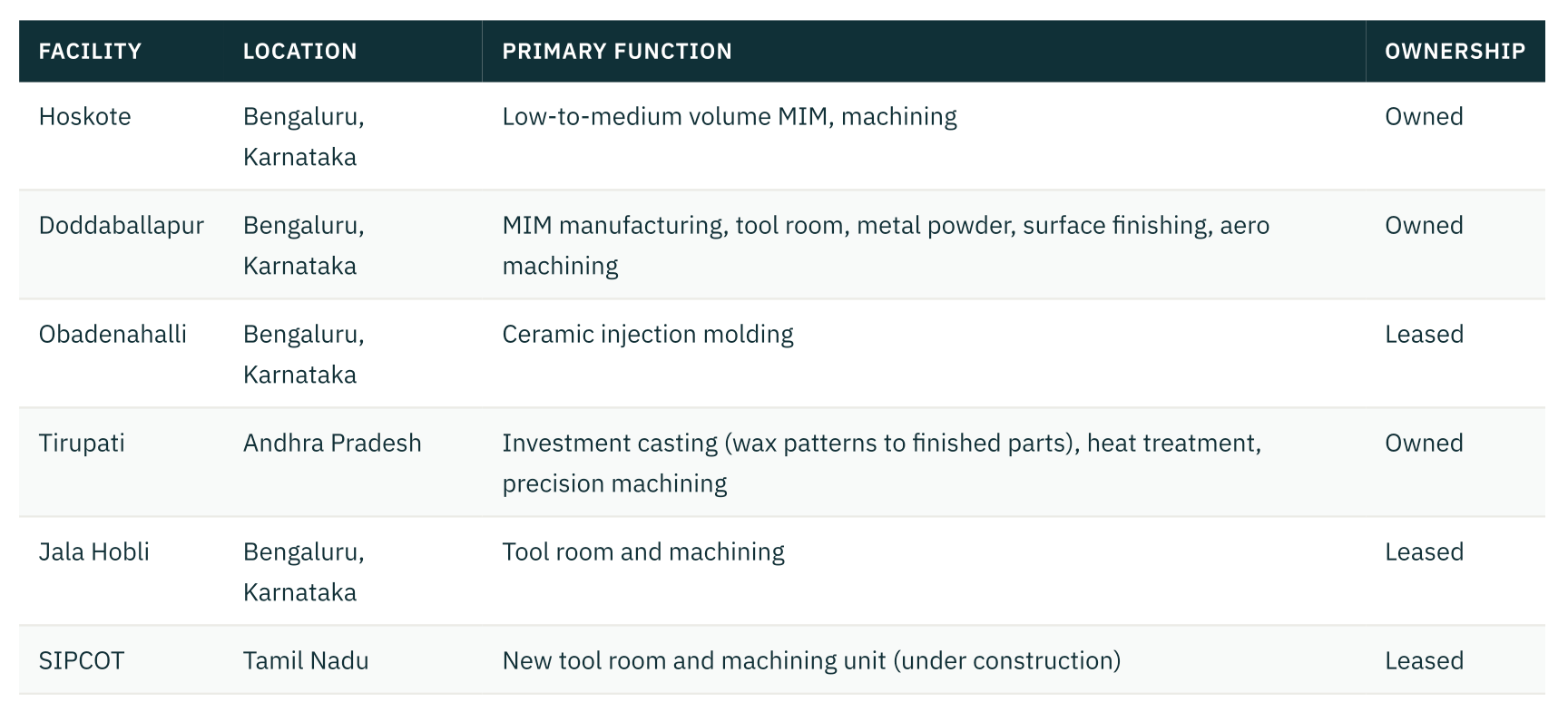
The Doddaballapur facility is the largest Indian site at 63,594 sq. mt. of land and 49,427 sq. mt. of buildings. It houses the continuous sintering furnace used for mass manufacture, the metal powder manufacturing operation, and the tool room. The Hoskote facility is the registered and corporate office, optimized for low-to-medium volume high-precision production. The SIPCOT Tamil Nadu facility is under construction and leased through 2121.
Four support facilities in India provide additional machining capacity (Tirupati, Obadenahalli, Majarahosahalli, Chokkahally), one handles third-party service providers (Peenya), and one is an assembly unit (Obadenahalli).
US operations (6 core facilities)
The US facilities operate through three subsidiaries. Indo-MIM Inc. runs a MIM factory and office in San Antonio, Texas (leased through 2037). Triax Industries LLC operates two facilities in Chandler, Arizona (leased/owned through 2065) for investment casting, covering the full process from wax pattern manufacturing through non-destructive testing, heat treatment, and finishing. Phoenix DeVentures II Inc. operates three facilities in Morgan Hill, California; Lehi, Utah; and Golden, Colorado, focused on medical device design and development.
UK operations (2 core facilities)
Conway Marsh Garrett Technologies Limited operates from Rendlesham, Woodbridge. One facility houses the MIM factory - powder storage, mixing, molding, debinding, sintering, and dispatch. The second facility contains the tool room and 3D printing operations. Both are leased through 2034. CMG was acquired for £10.53 million.
Mexico operations (1 core facility)
Indo-MIM Mexico operates a machining facility in Reynosa, Tamaulipas, leased through 2028. It supports Indo-MIM Inc. and Triax Industries. The ownership structure is unusual: Indo-MIM Inc. holds 49%, and Eduardo David Garcia, described as “a non-related local individual,” holds 51%. The company nonetheless accounts for Mexico as a subsidiary, stating it exercises significant control and bears substantially all risks of ownership and loss. Mexican law does not mandate an audit of this entity’s financial statements, and the company has relied on the consolidated audit of Indo-MIM Inc. for its financial information.
Backward integration strategy
Indo-MIM has begun producing stainless-steel powder in-house at its Doddaballapur facility, moving upstream into the primary raw material for MIM. The company states it is in the process of setting up an iron powder manufacturing facility at Gowribidanur Industrial Area, Chikkaballapur, Karnataka, with a target completion of end of Fiscal 2027. The land lease runs through 2120.
This matters because raw materials consumed were Rs 8,748.77 million in Fiscal 2026, representing 20.87% of revenue from operations. Of total raw material purchases, 60.95% were sourced from outside India in Fiscal 2026. Metal powders alone accounted for Rs 1,482.19 million of imports (16.95% of total raw material purchases). Producing stainless-steel and iron powder internally reduces import dependence and gives the company more material options to offer customers.
The Gowribidanur iron powder facility is contracted and under construction. The company also states it may explore “2K MIM technology” - a process molding two different MIM materials together in a single step - and aims to develop MIM copper material matching wrought copper properties. Both are stated intent, not built or contracted.
Automation and IoT deployment
As of March 31, 2026, the company has deployed 436 robots and 476 IoT-enabled machines across its manufacturing facilities. The IoT initiative collects real-time data from industrial machines to identify improvement opportunities in the production process. Robotics are used to eliminate non-value-added tasks, improve manpower productivity, and maintain consistent quality. The company also uses statistical process control tools and closed-loop injection molding equipment with proprietary enhancements.
Subsidiary structure and key acquisitions
The company has five direct subsidiaries and one indirect subsidiary. Three of the direct subsidiaries were acquired through transactions: Triax Industries (USD 12.50 million, Fiscal 2021, investment casting for aerospace), Conway Marsh Garrett Technologies (£10.53 million, MIM and 3D printing for the European market), and Phoenix DeVentures II (USD 15.80 million, medical device design and development). Indo-MIM Inc. was incorporated in 2016 as the US manufacturing arm. INDO-MIM Arms Components Private Limited was incorporated on December 5, 2025, to manufacture engineering metal parts.
Goodwill on acquisition of subsidiaries stands at Rs 1,128.33 million as of March 31, 2026, up from Rs 711.28 million in Fiscal 2025.
The statutory auditor, Suri & Co., did not audit the financial statements of five subsidiaries whose financials reflect total assets of Rs 15,788.77 million and total revenues of Rs 7,108.78 million for Fiscal 2026. Four of these are located outside India. The auditor relied on reports of other audit firms: Gould Killian CPA Group (US subsidiaries), Blick Rothenberg Audit LLP (UK subsidiary for FY2026), and MDA & Co. (INDO-MIM Arms). For the UK subsidiary’s FY2024 financials, the company relied on a review report rather than an audit, as local law did not mandate one.
Facility certifications
The manufacturing facilities hold NADCAP (aerospace special processes), IATF 16949:2016 (automotive), AS 9100:2016 (aerospace and defence), ISO 9001:2015 (quality management), ISO 14001:2015 (environmental), ISO 13485:2016 (medical devices), ISO 27001:2022 (information security), and ISO 45001:2018 (occupational health and safety). These certifications are prerequisites for serving OEMs in regulated industries - an automotive supplier must hold IATF 16949, and aerospace suppliers need AS 9100 and NADCAP for specific processes.
Workforce
As of March 31, 2026, the company had 4,424 permanent employees in India, of which 4,100 are engineers, metallurgists, designers, toolmakers, and technicians. An additional 497 trainees were employed in India. The company also engaged 2,766 contract labourers. Of the permanent workforce, 3,535 are in operations, 270 in automation, 295 in engineering, and 121 in marketing and customer support. The remaining 278 are spread across finance, HR, IT, and other support functions. Promoter Krishna Chivukula has over 30 years in the MIM industry, and CEO Krishna Chivukula Jr. has been with the company since September 2004. Both signed the financial statements from the United States - the CMD from Florida and the CEO from New York - while the company is headquartered in Bengaluru.
Technology platforms and product portfolio
Indo-MIM operates five distinct manufacturing technologies: metal injection molding (MIM), ceramic injection molding (CIM), investment casting, precision machining, and metal 3D printing. The company frames these as an integrated toolkit - a customer brings a complex geometry, and Indo-MIM selects the process that fits the tolerance, volume, material, and cost requirements. MIM is the core revenue engine. The other four technologies broaden the addressable part list, enable in-house finishing, and capture work that MIM alone cannot serve.
Metal Injection Molding (MIM)
MIM is a powder metallurgy process that produces near-net-shape metal components with complex geometries, tight tolerances, and mechanical properties the company states are “near equivalent or in some cases exceed wrought or cast processes.” The process works where conventional machining is too expensive or too slow for high-volume complex parts. The F&S report commissioned for the offer estimates MIM components typically cost 10% to 20% of the total cost of the final product, which is why OEMs are willing to invest years in qualifying a single supplier.
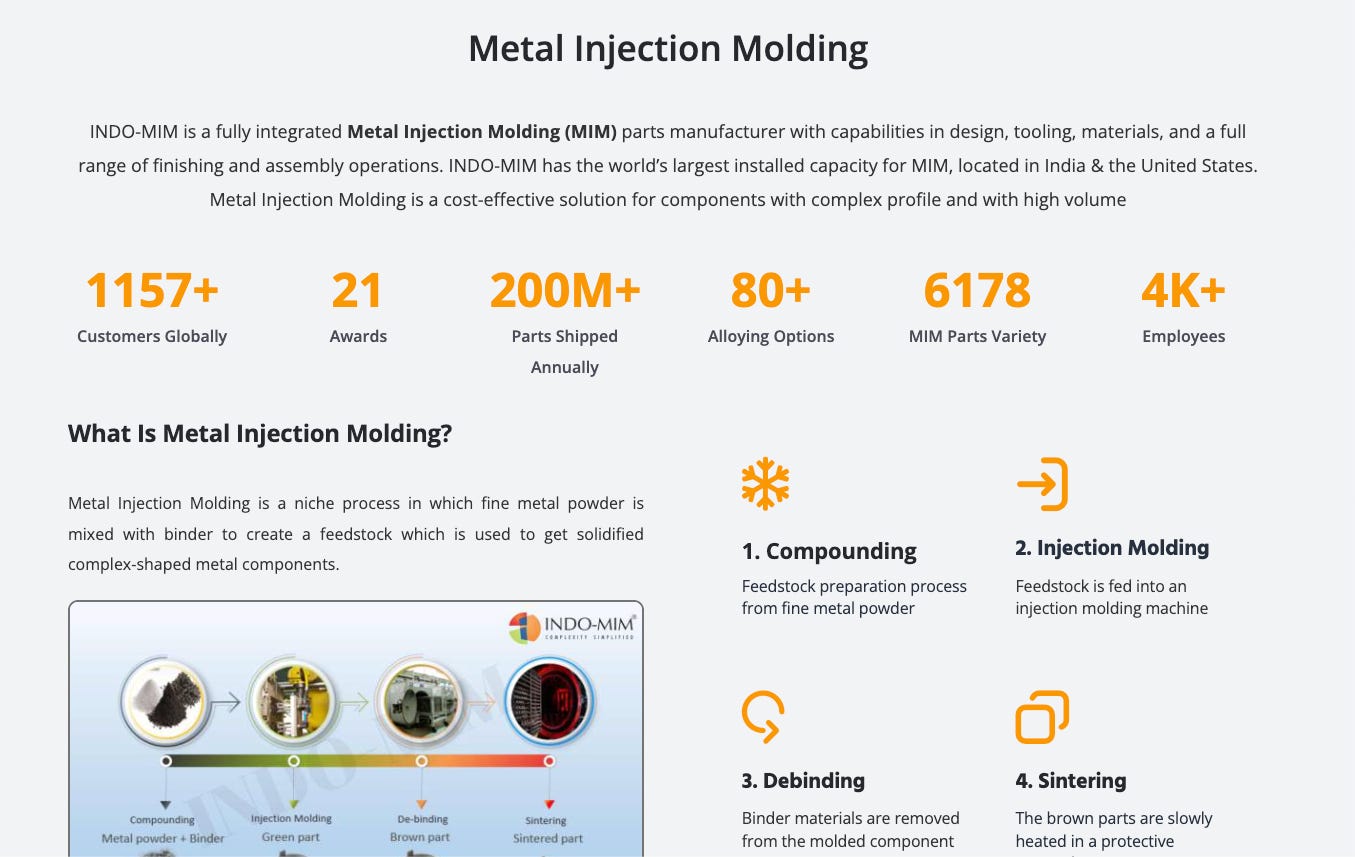
The MIM process at Indo-MIM has four stages. Compounding mixes metal powders with binder polymers (polypropylene, wax, stearic acid) into feedstock using batch compounding equipment in a controlled environment. Injection molding uses closed-loop molding machines with proprietary enhancements, monitored by statistical process control. Debinding removes binder constituents through a proprietary solvent extraction process. Sintering fuses the metal particles in either batch vacuum furnaces (for flexibility across alloys) or continuous pusher furnaces (for high-volume mass production). The Doddaballapur facility houses the continuous furnace dedicated to mass manufacture.
Indo-MIM offers over 80 different alloying options as of March 31, 2026, spanning low-carbon and high-alloy steels, multiple stainless steel families (austenitic, ferritic, martensitic, precipitation hardening), soft magnetic alloys, cobalt and nickel-base superalloys, and select non-ferrous alloys. Post-treatment options include hot isostatic pressing for demanding applications. The company produces 45 to 50 new tools per month, which the F&S report positions as among the fastest new-product-introduction rates in the MIM industry.
The in-house capabilities around MIM are what make the offering “end-to-end.” A metrology department equipped with video measuring systems, CMM with scanning head, surface roughness and roundness testers, and microfocus X-ray handles inspection. A materials laboratory performs chemical analysis (UV-Vis, energy dispersive X-ray fluorescence, Leco carbon/oxygen), metallurgical analysis (micrography, hardness testing, tensile testing, salt spray), and feedstock characterization (capillary rheometry, DSC, TGA). A tooling group manufactures precision injection molds, fixtures, and gauges using high-speed CNC milling, wire and sinker EDM, and precision grinding in a temperature-controlled environment. A multi-disciplined engineering group handles product design, mold design, FEA, and 3D flow analysis in ProEngineer and SolidCAM environments.
The engineering process starts at the proposal stage. The advanced product quality planning (APQP) team meets with customer representatives to plan each project step, with quality, product, tool, and manufacturing engineers working alongside field sales engineers. This front-end involvement is how the company positions itself as a design partner rather than a contract manufacturer.
Ceramic Injection Molding (CIM)
CIM uses the same injection molding principle as MIM but with ceramic feedstock instead of metal powder. The company operates CIM under a six sigma controlled environment at its Obadenahalli facility near Doddaballapur. CIM serves as an alternative to plastic and metal where wear resistance is the primary requirement. The F&S report positions CIM’s advantage as low-cost complex design capability that eliminates elaborate machining and finishing. The ceramic injection molding market is smaller than MIM - estimated at USD 450 million in 2025 growing to USD 626 million by 2030 at 6.8% CAGR. Indo-MIM uses CIM predominantly for in-house requirements rather than as a standalone revenue stream, and the company has not disclosed installed capacity or utilisation for this technology.
Investment Casting
Investment casting at Indo-MIM produces precision castings in steel, nickel, and cobalt base alloys for industrial and aerospace applications. The process handles parts weighing from 10 grams to 15 kilograms, up to 500 millimeters long, with wall thickness from 2 to 100 millimeters. This range covers everything from small aerospace brackets to large turbine-engine components. The technology base includes air melt casting, vacuum casting, and reverse gravity casting.
Two facilities run investment casting. The Tirupati facility in Andhra Pradesh (operated by Indo-MIM Limited) handles the full process from wax pattern manufacture through finished parts, equipped with precision machining and heat treatment. The Triax Industries facility in Chandler, Arizona (acquired in Fiscal 2021 for USD 12.50 million) runs investment casting for industrial and aerospace applications, with non-destructive testing capabilities including X-ray, fluorescent penetrant inspection, coordinate measuring machines, chemical etch lines, ceramic core leaching, and vacuum induction melting casting. Triax also operates an automated fettling rough clean cell, expected to be operational by end of Fiscal 2026.
The investment casting process has five stages. Design and engineering develops molds, fixtures, and performs scientific defect analysis with metallurgical support. The wax room produces patterns using 12-tonne to 35-tonne presses in temperature and humidity controlled environments, with capacity for 300 wax trees per day. The robotic shell room builds ceramic shell molds using UK-sourced equipment in a temperature and humidity controlled environment, with capacity for over 300 shell molds per day. Casting pours molten metal into the shells. Finishing removes the shell and performs grinding, blasting, and cut-off, followed by heat treatment and NDT.
Precision Machining
Precision machining is the finishing layer that makes MIM and investment casting components usable in customer assemblies. The company holds micron tolerances using statistical process control combined with high-precision metrology equipment. Capabilities include CNC turning and milling, centerless/ID/OD grinding, fine hole drilling, reaming and burnishing, precision honing, thread rolling and cutting, and laser welding, cutting, and drilling.
Precision machining operates at multiple facilities. The Hoskote facility has machining capability for finishing MIM components. The Doddaballapur facility houses aero machining. The Jala Hobli facility in Bengaluru Aerospace Park is dedicated to tool room and machining. The under-construction SIPCOT facility in Tamil Nadu will add a new tool room and machining unit. The Mexico facility in Reynosa supports machining for Indo-MIM Inc. and Triax Industries. Precision machining capacity at Doddaballapur had 1.41 million units of installed capacity with 54.75% utilisation in Fiscal 2026.
Metal 3D Printing
Metal 3D printing, or additive manufacturing, is the newest technology platform. Indo-MIM operates two distinct 3D printing processes. Binder Jet 3D Printing deposits metal powder layer by layer with a liquid binding agent, then sinters the bound structure to achieve final strength. This process eliminates the time-consuming melting step and is suited for mass production of lightweight components, functional prototypes, tooling, and end-use parts. The company states it is one of the first players to deploy the Desktop Metal Production System, described as the world’s first metal 3D printing system for mass production.
Laser Powder Bed Fusion uses a high-powered laser to selectively melt and fuse metal powders layer by layer under computer control. This process produces complex parts that consolidate multiple components into a single piece, reducing assembly time. Applications include turbine blades, medical implants, customized automotive parts, and high-performance tools.
The company also has lithography-based metal manufacturing capabilities. 3D printing is used predominantly for in-house requirements - rapid prototyping and complex component development - rather than as a standalone revenue stream. The company has not disclosed installed capacity or utilisation for 3D printing. The F&S report estimates the 3D printing market at USD 23 billion in 2025, growing at 22.3% CAGR to USD 63 billion by 2030, the fastest growth rate among the five technology platforms.
How the five technologies work together
The technology stack is designed so that a customer can source a complete component from a single supplier. A typical engagement starts with the engineering team reviewing the customer’s design and recommending the optimal manufacturing process. A small, complex, high-volume stainless steel part goes to MIM. A larger aerospace bracket requiring nickel or cobalt alloys goes to investment casting. A wear-resistant component goes to CIM. A prototype or low-volume complex part goes to 3D printing. Every part then moves through precision machining for finishing to micron tolerances, followed by surface treatment - electroless nickel and trivalent chromium plating, vacuum and sealed quench heat treating, and precision grinding - before assembly and dispatch.
This integration matters because OEMs in automotive, aerospace, medical, and defence face multi-year supplier qualification cycles. Once a supplier is qualified, the cost and effort of re-qualifying a second source for the same part is economically unattractive. By offering five manufacturing technologies under one roof, Indo-MIM increases the number of part types it can capture from a single customer relationship. The 9,000-plus product types manufactured in Fiscal 2026 - spanning more than 650 automotive products, more than 2,000 defence products, more than 650 medical products, more than 900 consumer products, and more than 2,000 aerospace products - reflect the breadth that the multi-technology platform enables.
End-use industry breakdown and revenue mix
How the five product groups fit together
Indo-MIM organises its business into five product groups plus an “Others” category. The structure matters because each group serves a different end-market with different volumes, qualification cycles, and pricing dynamics - and the mix has shifted materially in recent years.
Automotive (APG) is the largest segment at 24.61% of FY2026 revenue. Defence (DPG) and Medical (MPG) follow at 18.69% and 18.08% respectively, making them nearly equal in size. Aerospace contributes 11.96%, Consumer (CPG) is the smallest product group at 10.80%, and “Others” - which includes powder sales, tools, and traded products - accounts for 15.86%.
The F&S report commissioned for the offer frames the global MIM demand split differently, by end-use sector: defence 34.5%, automotive 29%, medical devices 17%, consumer goods 12%, and aerospace 2.5%. Indo-MIM’s revenue mix diverges from this industry split in two ways. Aerospace is 11.96% of company revenue against a 2.5% global MIM demand share, reflecting the company’s investment casting and precision machining capabilities serving aerospace OEMs rather than pure MIM. Defence at 18.69% is well below the 34.5% global figure, partly because Indo-MIM’s defence revenue is concentrated in firearm components for specific OEMs rather than the broader defence MIM market.
The “Others” category at 15.86% is larger than both Consumer and Aerospace individually. This bucket includes sale of powder, tools, and traded products - revenue that sits outside the five product groups but is a direct byproduct of Indo-MIM’s backward integration into stainless-steel and iron powder production and its tool-making capability. As the company’s powder manufacturing capacity expands with the Gowribidanur iron powder facility, this category’s composition and significance will shift.
What each segment actually makes
The five product groups share a common manufacturing platform - MIM, investment casting, ceramic injection molding, precision machining, and metal 3D printing - but each serves distinct applications and OEM customers with different volume and validation profiles.
Automotive (APG, 24.61%) manufactures components for vehicle safety, fuel systems, powertrains, and interiors. Specific products include vanes for turbochargers, gear segments for fuel injection pumps, and pawls for seat belts. These are high-volume, precision-critical parts where MIM’s near-net-shape capability and low waste (3% or lower versus 20-50% for stamping) matter. The F&S report estimates MIM demand from automotive growing at 9.0% CAGR through CY 2030, driven by lightweighting and EV transition creating new applications in battery systems and power electronics.
Defence (DPG, 18.69%) manufactures firearm components: triggers, hammers, sights, magazine catches for assault rifles, slide stops for pistols, and sears for revolvers. These are lower-volume, high-precision parts where single-sourcing is the norm. The F&S report notes that defence MIM demand is the largest global segment at 34.5%, growing at 8.8% CAGR. Indo-MIM’s top customer relationship spans 17 years and sits in this segment, consistent with the 2-3 year supplier onboarding cycle and the single-sourcing practices described in the offer document.
Medical (MPG, 18.08%) manufactures components for surgical devices used in endoscopy, laparoscopy, dental robotics, and orthopedics. Products include jaws, cartridge bases, and sound tubes. The F&S report projects medical devices as the fastest-growing MIM end-use segment at 11.6% CAGR through CY 2030, driven by implantable MIM products for drug delivery systems and joint replacement. Indo-MIM’s 2025 acquisition of Phoenix DeVentures II in the US was specifically aimed at expanding this segment.
Consumer (CPG, 10.80%) supplies products for fashion accessories, crossbow parts, cellphone components, tools, and hardware applications including housings, pipe clamps, and latches. This is the segment where Chinese MIM manufacturers dominate globally, concentrated on smartphone and consumer electronics components. The F&S report notes that China controls 53% of global MIM production (USD 2.11 billion), largely driven by consumer electronics OEMs in the Zhujiang Delta. Indo-MIM’s consumer segment is smaller and more diversified than its Chinese competitors’ exposure.
Aerospace (11.96%) manufactures manifolds, precision housings, adaptors, tees, servo motor housings, nozzles, locking rings, clevises, and brackets for aerospace OEMs. The F&S report estimates aerospace as only 2.5% of global MIM demand but growing at 9.2% CAGR. Indo-MIM’s aerospace revenue likely includes investment casting output from its Triax Industries acquisition (vacuum casting for land-based gas turbines and aerospace) alongside MIM components. The segment’s share of company revenue at 11.96% versus 2.5% of global MIM demand signals that Indo-MIM’s aerospace business draws on multiple manufacturing technologies, not just MIM.
The “Others” category and growth trends
The “Others” bucket at 15.86% of FY2026 revenue includes sale of powder, tools, and traded products. This is not a residual of miscellaneous income - it reflects Indo-MIM’s backward integration strategy. The company manufactures its own feedstock through the “elemental way” (mixing powders and binders in-house rather than buying premix compounds), giving it design freedom that most MIM competitors lack. Powder and tool sales to external customers are a direct output of that capability.
The Gowribidanur iron powder facility, targeted for completion by end of FY2027, will expand the powder production capacity that feeds this category. The F&S report identifies raw material and feedstock availability as a key industry challenge, with concentrated supply of MIM-grade powders and long qualification cycles creating supply chain rigidity. Indo-MIM’s backward integration into powder manufacturing directly addresses this vulnerability.
The offer document does not disclose a year-on-year trend breakdown for the “Others” category specifically, so the trajectory of this segment cannot be assessed from the disclosed figures. What is visible is that “Others” at 15.86% is larger than two of the five named product groups, and its composition will shift as the iron powder plant comes online and as the company’s tool room and machining unit in Tamil Nadu scales up.
Segment-level growth context
The F&S report projects the overall MIM market growing at 9.2% CAGR from USD 4.0 billion in CY 2025 to USD 6.2 billion by CY 2030. Medical devices are projected as the fastest-growing end-use at 11.6% CAGR, followed by automotive at 9.0%, defence at 8.8%, aerospace at 9.2%, and consumer electronics at 8.2%. These are industry-level projections from a report commissioned and paid for by Indo-MIM, and they assume a baseline scenario where the US-Iran conflict resolves by late Q2 or early Q3 of CY 2026.
Indo-MIM’s own revenue grew 25.93% in FY2026, well above the F&S projected global MIM market growth rate. Whether this gap reflects market share gains, capacity additions coming online, or the inclusion of non-MIM revenue (investment casting, precision machining, 3D printing) in the company’s growth figures is not disaggregated in the offer document.
Automotive Products Group (APG)
APG makes metal components that go into vehicle safety systems, fuel systems, powertrains, and interior applications. The specific products the offer document names are turbocharger vanes, gear segments for fuel injection pumps, rocker arms for engines, sensor housings, and pawls for seat belts. These are small, geometrically complex parts produced through metal injection molding (MIM), where metal powder and binder are molded, debound, and sintered into near-net-shape components. The F&S report commissioned for this offer estimates that MIM components typically cost only 10% to 20% of the final product’s total cost, making the technology attractive for high-volume automotive manufacturing.
The core barrier that took years to build is the supplier qualification cycle. The F&S report states that onboarding a precision component supplier typically takes 2 to 3 years, involving supplier audits, trial runs, and periodic inspections. Once a supplier is qualified, the component is typically sourced from that single supplier because the cost of dedicated tooling and the burden of stringent validation make dual sourcing economically unattractive. This creates embedded relationships that are difficult for competitors to displace.
APG is the largest segment in INDO-MIM’s portfolio by revenue, contributing ₹10,317.93 million in Fiscal 2026, or 24.61% of total revenue from operations. Revenue has grown from ₹8,731.26 million (30.42%) in Fiscal 2024 to ₹9,591.92 million (28.81%) in Fiscal 2025. The segment’s share of total revenue has declined over three years, falling from 30.42% to 24.61%, as other segments - particularly Aerospace and the “Others” category (powder, tools, and traded products) - grew faster. APG served 193 customers in Fiscal 2026, up from 176 in Fiscal 2024, and manufactured more than 650 product types during the year.
The offer document does not disclose segment-level capacity, utilisation, or plant-specific data for APG. The company states that its manufacturing facilities are fungible across end-use industries because the underlying MIM process is the same regardless of whether a part goes into a turbocharger or a firearm. Total MIM installed capacity across all facilities was 874.56 million parts as of March 31, 2026, with actual production of 267.42 million parts, yielding 30.58% utilisation. APG parts are produced at the Hoskote and Doddaballapur facilities in India, the San Antonio facility in the US, and the CMG facility in the UK, but the company does not break out how much of that capacity or production was consumed by automotive specifically.
The company does not name APG-specific customers. The top five customers across all segments contributed 28.95% of total revenue in Fiscal 2026, down from 30.97% in Fiscal 2024, indicating broad diversification. Automotive OEMs buy from INDO-MIM because the MIM process produces complex geometries at high volume with minimal material waste, and because the dual-shore manufacturing footprint (India, US, UK, Mexico) provides supply chain security. The company holds IATF 16949:2016 certification, which is the required quality management standard for the global automotive supplier base. The F&S report forecasts that demand for MIM parts from the automotive sector will grow at a CAGR of 9.0% from 2025 to 2030, slightly below the 9.2% growth forecast for the overall MIM market.
The company names its peer set as Jiangsu Gian Technology Co, Zoltrix Material International Limited, GKN Powder Metallurgy, Future Tech, Schunk Group, ARC Group Worldwide, Parmatech, Nippon Piston Rings, and MPP Innovation. Of these, only Jiangsu Gian Technology is publicly listed. The F&S report states that the top ten global MIM manufacturers hold a combined 37% market share, with INDO-MIM claiming 6.8% and the largest position for six consecutive years. The remaining 63% of the market is fragmented across smaller players, several of whom are named as peers above.
Defence Products Group (DPG)
DPG manufactures firearm components for defence OEMs. The product list is specific: magazine catches for assault rifles, slide stops for pistols, sears for revolvers, safety mechanisms for sub-machine guns, and sights for machine guns. In Fiscal 2026, the company supplied more than 2,000 distinct product types under this segment, the highest product count alongside aerospace across all its groups.
The core capability here is metal injection molding (MIM) applied to components that must withstand repeated mechanical shock and high fatigue loads. The F&S report commissioned for the offer states that MIM performs better than conventional machining for gun triggers because of its fatigue qualities and ability to produce complex near-net-shapes. INDO-MIM’s in-house tooling design, proprietary solvent debinding, and vacuum sintering allow it to hit the dimensional tolerances these parts require.
The document does not disclose segment-level capacity or utilisation. Manufacturing facilities are fungible across end-use industries, and the company explicitly states it cannot compute installed capacity, actual production, or utilisation for individual product groups. MIM capacity across the Hoskote, Doddaballapur, and UK facilities totalled 874.56 million installed units in Fiscal 2026, with overall MIM utilisation at 30.58%. Defence components compete for that same capacity.
DPG contributed 18.69% of revenue in Fiscal 2026, down from 26.80% in Fiscal 2025 and 27.34% in Fiscal 2024. In absolute terms, segment revenue fell from ₹8,923.09 million to ₹7,836.82 million year-on-year. This is the only segment in the company’s core portfolio that contracted in Fiscal 2026.
The customer base is concentrated. The company’s top five customers in Fiscal 2026 included two from DPG. One relationship began in Fiscal 2010 (17 years) and another in Fiscal 2014 (13 years). The company served 133 DPG customers in Fiscal 2026, down marginally from 134 the prior year. The F&S report attributes the stickiness of these relationships to the economics of single-sourcing: dedicated tooling costs and stringent validation make dual-sourcing economically unattractive for OEMs. The onboarding cycle itself takes 2 to 3 years, involving supplier audits, trial runs, and periodic inspections.
The company incorporated a new wholly-owned subsidiary, INDO-MIM Arms Components Private Limited, on December 5, 2025, to carry out the business of manufacturing engineering metal parts. The offer document does not specify whether this subsidiary will absorb existing DPG production or pursue new defence contracts, but its name signals an intent to formalise the arms components business as a distinct legal entity.
The competitive landscape is not segment-specific. INDO-MIM competes globally across all product groups against the same peer set: Jiangsu Gian Technology, Zoltrix Material International, GKN Powder Metallurgy, Future Tech, Schunk Group, ARC Group Worldwide, Parmatech, Nippon Piston Rings, and MPP Innovation. The F&S report notes that only Jiangsu Gian Technology is publicly listed. The company claims a 6.8% global market share of MIM revenue in Calendar Year 2025 and states it has held the largest manufacturer position for six consecutive years.
The F&S report forecasts global defence MIM demand growing at an 8.8% CAGR between 2025 and 2030, against a global defence market of USD 600 billion in 2025 growing at 7%. The company’s strategy section cites increased FDI limits in India’s defence sector and “make in India” initiatives as tailwinds for capturing domestic arms manufacturing opportunities.
Medical Products Group (MPG)
MPG manufactures precision components for surgical devices used in endoscopy, laparoscopy, dental robotics, and orthopedics. The specific products disclosed include jaws for laparoscopy, cartridge bases for surgical staplers, base and adaptors for orthopedic applications, sound tubes for hearing aids, and blades for spine surgery. The company manufactured more than 650 types of medical products in Fiscal 2026.
The core capability underlying these parts is metal injection molding (MIM), a process that shapes metal powder and binder mixtures into complex, near-net-shape components. Medical device OEMs require biocompatible materials, micron-level tolerances, and surface finishes that survive sterilization and surgical use. INDO-MIM offers over 80 different alloying options, including stainless steels and titanium alloys, and applies in-house surface treatments like electroless nickel plating and vacuum heat-treating to meet these specifications.
The company holds ISO 13485:2016 certification for medical device manufacturing. It acquired Phoenix DeVentures II Inc. in Fiscal 2021 for USD 15.80 million, a US-based entity engaged in medical device design and development. Phoenix DeVentures operates across three US facilities (Morgan Hill, California; Lehi, Utah; and Golden, Colorado). The UK subsidiary Conway Marsh Garrett Technologies Limited also supplies injection moulded components to the medical sector. The Mexico facility performs primary and secondary operations on medical products.
MPG generated ₹7,579.82 million in revenue in Fiscal 2026, accounting for 18.08% of total revenue from operations. This is up from ₹5,773.04 million (17.34%) in Fiscal 2025 and ₹5,618.82 million (19.58%) in Fiscal 2024. Revenue grew 31.3% year-over-year in Fiscal 2026, outpacing the company’s overall revenue growth of 25.93%.
The customer base for MPG stood at 95 customers in Fiscal 2026, flat compared to 95 in Fiscal 2025 and up from 89 in Fiscal 2024. Customer 3, one of the company’s top five customers overall, belongs to the MPG segment and has a relationship with INDO-MIM spanning 17 years since Fiscal 2010. The company does not disclose segment-specific customer concentration, but company-wide repeat customers contributed 91.60% of revenue in Fiscal 2026.
Medical device OEMs buy these components through a rigorous qualification process. The F&S report commissioned for the offer states that onboarding a supplier typically takes 2 to 3 years, involving supplier audits, testing, trial runs, and periodic inspections. Once qualified, a precision component is typically sourced from a single supplier because the cost of dedicated tooling and the burden of validation make dual sourcing economically unattractive. This single-sourcing practice locks incumbents into recurring production orders.
The document does not disclose segment-specific capacity, capacity utilization, or plant-level production data for MPG. The company states that production capabilities are fungible across product groups and that it cannot compute installed capacity, available capacity, actual production, or capacity utilization for each product segment individually. Capacity is reported only at the technology level (MIM, precision machining, investment casting) across specific facilities.
The F&S report estimates that demand for MIM products in the medical sector will grow at a CAGR of 11.6% between 2025 and 2030, driven by the global medical devices market which was valued at USD 572.3 billion in 2025. INDO-MIM competes in this segment against the same peer set it faces across all product groups: Parmatech, ARC Group Worldwide, Schunk Group, GKN Powder Metallurgy, and others named in the F&S report. None of these competitors are broken out by medical-specific market share.
Consumer Products Group (CPG)
The Consumer Products Group supplies precision-engineered components for fashion accessories, crossbow parts, cellphone components, tools, and hardware applications. The product range disclosed for Fiscal 2026 includes housings for microwave ovens, pipe clamps for piping, 3C parts for mobile phones, latches for multi-utility tools, and cams for connectors. The company manufactured more than 900 distinct product types under this segment in Fiscal 2026.
CPG contributed ₹4,530.34 million to revenue in Fiscal 2026, representing 10.80% of total revenue from operations. This is an increase from ₹3,253.76 million (9.77%) in Fiscal 2025 and ₹2,746.77 million (9.57%) in Fiscal 2024. The segment is the company’s smallest revenue contributor among the five product groups, sitting behind Automotive, Defence, Medical, and Aerospace.
The core capability underpinning these products is metal injection molding (MIM). MIM allows the company to produce complex geometries in high volumes that would be difficult or expensive to machine from solid metal. The company states that the cost of MIM components is typically 10% to 20% of the total cost of the final product, which makes the technology viable for consumer applications where unit economics are tight. Building the tooling and validating the manufacturing process for each new consumer part takes time. The company states that onboarding a new supplier in this industry typically takes 2 to 3 years, involving audits, testing, trial runs, and periodic inspections.
The offer document does not disclose dedicated capacity or utilisation figures for CPG. The company explicitly states that because its manufacturing technologies are fungible and production is based on customer requirements, it cannot compute installed capacity, available capacity, actual production, or capacity utilisation for each individual product group. CPG parts run through the same MIM furnaces at Hoskote and Doddaballapur in India, the San Antonio facility in the US, and the Conway Marsh Garrett facility in the UK. Overall MIM capacity across these four facilities stood at 874.56 million parts as of March 31, 2026, with actual production of 267.42 million parts, yielding a 30.58% utilisation rate.
CPG served 220 customers in Fiscal 2026, up from 199 in Fiscal 2025 and 163 in Fiscal 2024. The company does not name specific CPG customers in the offer document. The customer base is broad rather than concentrated, which aligns with the diverse end-use applications ranging from crossbow manufacturers to cellphone brands. The company’s top five customers across all segments accounted for 28.95% of revenue in Fiscal 2026, and no single customer exceeded 7.97% of revenue. The document does not break out customer concentration specifically for CPG.
The company’s competitive position in CPG rests on the same MIM platform that supports its other segments. It claims to be the largest global manufacturer of precision engineering components using MIM technology, with a 6.8% market share in Calendar Year 2025, a position it has held for six years according to the Frost & Sullivan report commissioned for the offer. Named competitors across the company’s peer set include Jiangsu Gian Technology, Zoltrix Material International, GKN Powder Metallurgy, Future Tech, Schunk Group, ARC Group Worldwide, Parmatech, Nippon Piston Rings, and MPP Innovation. The document does not isolate competitors by segment.
A relevant development for the CPG segment is the joint venture with AUFLEX Co. Ltd. of South Korea. The proposed entity, INDO Flex Precision Private Limited, will produce foldable hinge modules in India. Foldable hinges are a consumer electronics component, and this JV directly targets the cellphone hardware market that CPG already serves through its 3C parts. The company will hold 49% of the JV, with AUFLEX holding 51%. The JV agreement was dated November 30, 2024, and the entity is still being set up.
Aerospace Products Group
The Aerospace Products Group manufactures precision components for aerospace OEMs, including manifolds, precision housings, adaptors, tees, servo motor housings, nozzles, locking rings, clevises, and brackets. The company maps these parts to specific aircraft applications: manifolds and housings go into actuation systems, adaptors and tees into hot section engine modules, servo motor housings into engine fuel monitoring units, and nozzles and locking rings into engine inlet gearboxes.
This segment draws on two distinct manufacturing technologies. The first is MIM, the company’s core process, which produces smaller, complex geometries. The second is investment casting, which the company acquired through its 2021 purchase of Triax Industries, a US-based entity, for USD 12.50 million. The Triax acquisition specifically brought in-house investment casting capabilities for industrial and aerospace applications, allowing the company to manufacture larger parts weighing 10 grams to 15 kilograms, up to 500 millimeters long, with wall thicknesses ranging from 2 to 100 millimeters.
The offer document does not disclose segment-specific installed capacity, production volume, or utilisation for aerospace products. The company states its facilities are fungible across end-use industries due to shared manufacturing processes, and it does not compute capacity at the individual product or segment level. However, the Triax facilities in Chandler, Arizona, house the dedicated investment casting lines for aerospace, equipped with non-destructive testing (x-ray, fluorescent penetrant inspection), heat treatment, and vacuum induction melting casting.
Aerospace is the company’s fifth-largest segment by revenue, contributing ₹5,014.81 million in Fiscal 2026, or 11.96% of revenue from operations. This is up from ₹3,762.75 million (11.30%) in Fiscal 2025 and ₹2,818.39 million (9.82%) in Fiscal 2024. The segment served 97 customers in Fiscal 2026, down from 101 the prior year but flat against 97 two years prior.
Customer relationships in aerospace are structurally sticky. The F&S report commissioned for the offer states that onboarding a supplier in this industry takes 2 to 3 years, involving supplier audits, trial runs, and periodic inspections. The report also notes that precision components are typically single-sourced because the cost of dedicated tooling and the burden of validation make dual sourcing economically unattractive. This locks incumbents into the OEM’s supply chain and creates a high barrier for new entrants.
The company holds AS 9100:2016 certification, the quality management standard specific to aerospace, and NADCAP accreditation for its aerospace products, which is the specialized process certification required by aerospace primes. The company received an “Outstanding Supplier Performance Award” from RTX in 2025, indicating an active relationship with one of the largest aerospace and defence OEMs globally.
Competition is not segmented by end-use industry in the offer document. The company lists its global peers across all segments as Jiangsu Gian Technology, Zoltrix Material International, GKN Powder Metallurgy, Future Tech, Schunk Group, ARC Group Worldwide, Parmatech, Nippon Piston Rings, and MPP Innovation. Of these, only Jiangsu Gian Technology is publicly listed.
Others
The “Others” segment bundles three distinct revenue streams: sale of powder, tools, and traded products. The offer document discloses no separate capacity, utilisation, or margin figures for this segment. Its revenue scale and growth trajectory are the headline facts.
Revenue mix and growth
Revenue from this segment has grown sharply across the three reported years:

This is the fastest-growing segment in the company’s portfolio by revenue share, expanding from 3.27% to 15.86% of total revenue over two years. FY2026 revenue of ₹6,650.13 million is more than triple the prior year. The document does not break down how much of this comes from powder versus tools versus traded products, so the investor cannot see which sub-stream is driving the surge.
What the segment actually does
The three product lines serve different functions:
Powder: INDO-MIM manufactures stainless-steel powder in-house at its Doddaballapur facility as part of a backward integration strategy. This powder is a critical raw material for the MIM process. The company is also setting up a new iron powder manufacturing facility at Gowribidanur Industrial Area, Chikkaballapur, Karnataka, with a target completion of end of Fiscal 2027. This suggests powder production is moving from a cost-saving internal measure to a revenue-generating business line, as the segment includes external “sale of powder.”
Tools: The company houses a tooling group at its facilities that manufactures precision injection molds, fixtures, and gauges. These tools are essential for the MIM process. The company produces 45 to 50 new tools per month, which the F&S report commissioned for the offer states is among the fastest in the MIM industry for new product introductions. Tooling is sold to customers as part of the initial product development cycle - when a customer places an order, they typically acquire the tool first, then order the actual product.
Traded products: The document does not define what traded products are or what they include. No further detail is available on what is bought and resold, to whom, or at what margins.
Why customers buy
For powder, the customer base would include other MIM manufacturers or industries requiring metal powders, though the document does not name specific powder customers. The backward integration into powder manufacturing gives INDO-MIM control over a critical input - the cost of materials consumed was ₹8,748.77 million in FY2026, representing 20.87% of revenue from operations. Metal powders alone (sourced from both India and outside) accounted for ₹1,562.34 million of purchases in FY2026. Producing powder internally reduces dependence on external suppliers, of which the company used 753 in FY2026.
For tools, customers buy them as a prerequisite step before placing component orders. The tooling is designed and manufactured in-house, which means INDO-MIM captures that margin rather than outsourcing. The tool also creates a switching cost: the F&S report states that “the cost of dedicated tooling and the burden of stringent validation make dual sourcing economically unattractive,” locking customers into a single-supplier relationship.
Manufacturing footprint
The segment does not have dedicated manufacturing facilities listed separately. Powder production happens at Doddaballapur (stainless-steel powder) and will expand to Gowribidanur (iron powder). Tooling is spread across multiple facilities, including the Jala Hobli facility (dedicated tool room and machining) and the new SIPCOT facility in Tamil Nadu (new unit for tool room and machining). The company does not disclose installed capacity, available capacity, actual production, or capacity utilisation for this segment. The capacity tables cover only MIM technology, precision machining, and investment casting technology.
Competitive position
The document does not identify any segment-specific competitors for powder, tools, or traded products. The company’s broader peer set includes Jiangsu Gian Technology, Zoltrix Material International, GKN Powder Metallurgy, Future Tech, Schunk Group, ARC Group Worldwide, Parmatech, Nippon Piston Rings, and MPP Innovation. Whether these peers sell powder or tools externally is not addressed. The company’s in-house powder production and tooling capability do represent a structural advantage over competitors who must outsource these inputs, but the document does not quantify that advantage.
What the investor is left with
This segment went from a rounding error (3.27% of revenue) to a meaningful contributor (15.86%) in two years, driven by revenue growth that the document does not decompose. The powder business has a clear strategic logic - backward integration into a critical raw material, with a new iron powder plant coming online by FY2027. The tools business is a natural extension of the company’s mold-design capability. Traded products are undisclosed. The investor cannot assess margins, capacity utilisation, or customer concentration for this segment from the offer document.
Customer relationships and the supplier qualification lock-in
The structural feature that defines Indo-MIM’s commercial model is the friction embedded in supplier onboarding. The F&S report commissioned for the offer states that OEM onboarding of a precision component supplier takes two to three years, involving supplier audits, testing, trial runs, periodic reviews, and inspections of procurement, manufacturing, logistics, and other capabilities. This timeline exists because MIM components go into safety-critical and performance-critical assemblies - firearm triggers, seat belt pawls, turbocharger vanes, surgical instruments - where a dimensional or material failure has downstream consequences far exceeding the component’s own cost.
The F&S report also states that MIM components typically represent only 10-20% of the total cost of the final product. This low cost share, combined with the validation burden, means OEMs have little economic incentive to qualify a second source once a supplier is approved. The offer document puts it directly:
“Across the industries we serve, a precision component is typically sourced from a single supplier because the cost of dedicated tooling and the burden of stringent validation make dual sourcing economically unattractive.”
This single-sourcing practice is the mechanism behind Indo-MIM’s repeat order economics. In FY2026, repeat customers - defined as customers who purchased in either of the two immediately preceding fiscal years - contributed 91.60% of revenue from operations. The figure was 90.91% in FY2025 and 93.76% in FY2024. In absolute terms, repeat customer revenue grew from Rs 26,912.34 million in FY2024 to Rs 38,406.18 million in FY2026. New customer revenue in FY2026 was Rs 3,523.67 million, or 8.40% of revenue from operations.
The company served 1,100+ customers across 55 countries in FY2026. Customer counts by end-use industry were: APG 193, CPG 220, DPG 133, MPG 95, and Aerospace 97, totalling 738. The discrepancy between 738 and the 1,100+ figure likely reflects customers in the “Others” category (powder, tools, traded products) and those served through subsidiaries or sales representatives not mapped to a specific product group.
Customer concentration
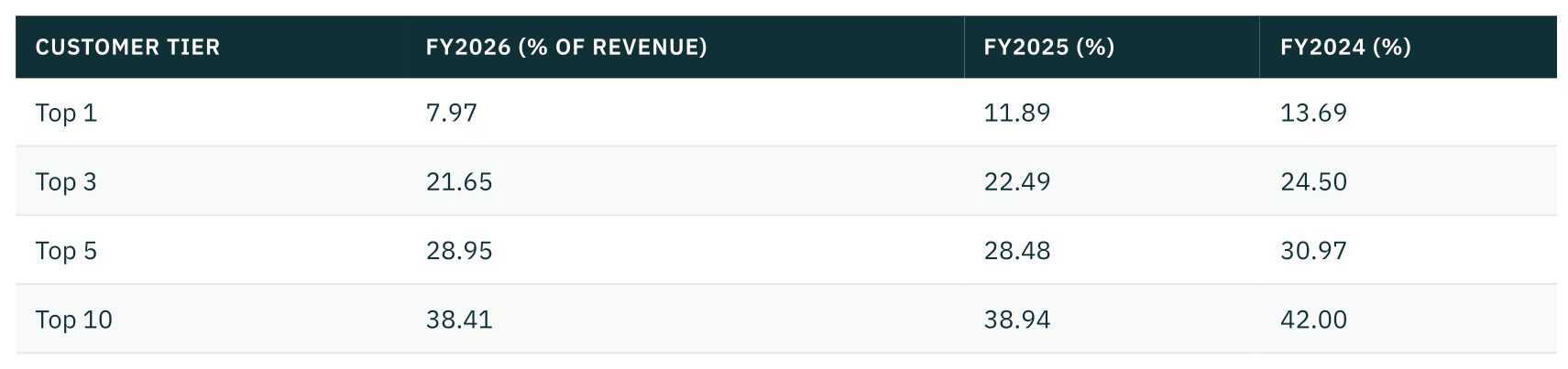
Concentration has been declining. The top 5 customers contributed 28.95% of revenue in FY2026, down from 28.48% in FY2025 and 30.97% in FY2024. The top 10 contributed 38.41%, down from 38.94% and 42.00% respectively. The top single customer contributed 7.97% in FY2026, a notable drop from 11.89% in FY2025 and 13.69% in FY2024, suggesting either a volume reduction from that customer or faster growth from other accounts.
The top 5 customer relationships by revenue in FY2026 show deep tenure in defence and medical, with newer entrants in end-use categories labelled ECM (likely an emerging category or customer group not mapped to the five primary product groups):
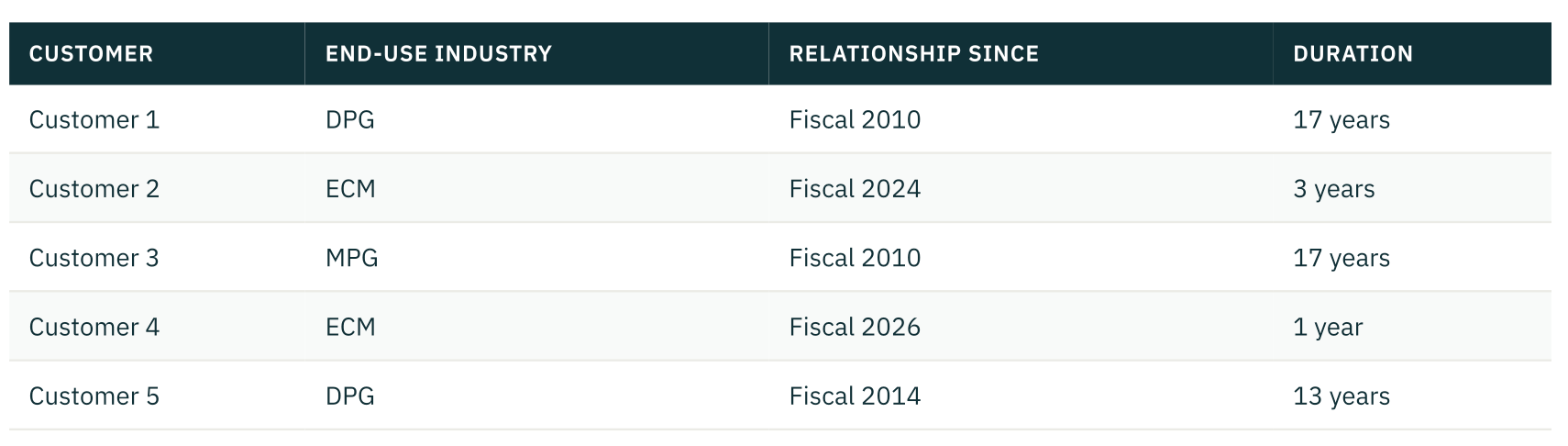
Two of the top 5 customers have been with Indo-MIM for 17 years, both originating in FY2010. Customer 5’s 13-year relationship dates to FY2014. Customer 4 is a first-year relationship in FY2026, which means it entered the top 5 in its initial year - implying either a large launch program or a significant contract win. The presence of two ECM customers in the top 5 (one with only 3 years and one with 1 year) indicates that Indo-MIM is successfully converting newer relationships into meaningful revenue, not just relying on legacy accounts.
Contract structure and the absence of committed volumes
The qualification lock-in creates de facto customer stickiness, but the legal contract structure provides no contractual floor. The company states it generally does not have long-term arrangements or firm quantity commitments with customers. Orders are placed on a purchase order basis. Customers use either discrete purchase orders (specific quantity and delivery date) or open purchase orders (quantities and dates with delivery schedules communicated separately). Some customers provide monthly or weekly rolling schedules where the initial weeks are firm and binding, but subsequent schedules are tentative and non-binding. Customers can amend these schedules without cause.
The company does maintain purchase and supply agreements with some customers, but these set general terms and conditions only. They do not bind customers to specific volumes or durations and can be terminated with or without cause and without compensation. This means the 91.6% repeat rate is driven by switching costs and validation economics, not by contractual obligation. An OEM that wanted to move a component to a different supplier would need to re-run the two-to-three-year qualification cycle, absorb dedicated tooling costs, and accept the risk that the new supplier’s parts may not perform identically in the assembly. For a component that costs 10-20% of the final product’s cost, that math does not work unless the incumbent supplier has a material quality or pricing failure.
New customer acquisition
Indo-MIM added 308 new customers in FY2026 (139 domestic, 169 overseas), up from 269 in FY2025 and 194 in FY2024. New customer revenue was Rs 3,523.67 million in FY2026, Rs 3,024.96 million in FY2025, and Rs 1,791.56 million in FY2024. The overseas new customer count nearly tripled from 57 in FY2024 to 169 in FY2026, consistent with the company’s dual-shore manufacturing footprint and its sales offices in China, Germany, and the United States, plus 13 sales representatives across nine countries.
The new customer revenue as a percentage of total revenue has been 6.24% in FY2024, 9.09% in FY2025, and 8.40% in FY2026. These customers take time to scale - a customer onboarded in FY2026 with a first order may not reach meaningful volumes until FY2028 or later, given the tooling development cycle and the time between sample approval and production orders. The company produces 45 to 50 new tools per month, which sets the pace at which new programs can move from quotation to sample to production.
Customer awards as validation evidence
The offer document lists quality and performance awards from named customers: Cummins (Best of Best Quality Award 2025, Best Safety Practice Award 2024), Bajaj BAVA (Quality Award Super Platinum 2025), Bosch (Supplier Excellence Award 2025, India Sustainability Supplier Award 2024), Schaeffler (Quality Award 2025), RTX (Outstanding Supplier Performance Award 2025), BHEL (appreciation for bucket casting development for FR-5 Stage #1 gas turbines, 2024), StanleyBlack&Decker (Best Process Control Award 2023), SMP Oil & Gas (Distinguished Supplier Award 2023), Caterpillar (Supplier Excellence Recognition 2022), and Hero Motors (Best Innovation & Cost Performance Award 2022). These awards span automotive, aerospace, defence, consumer, and industrial customers, and they come from entities that conduct their own quality audits of Indo-MIM’s facilities. The concentration of awards in 2024-2025 suggests the company has been deepening relationships with existing customers rather than just adding new ones.
What could break the lock-in
The qualification barrier cuts both ways. If Indo-MIM itself has a quality failure on a safety-critical component - a seat belt pawl, a firearm trigger, a surgical instrument - the OEM’s switching cost calculus changes. A supplier qualification that takes two to three years also means that if Indo-MIM loses a customer relationship due to a quality incident, rebuilding that revenue stream with a replacement customer requires the same two-to-three-year cycle. The company’s CAPA system, its six-sigma controlled ceramic injection molding process, and its SPC tools on injection molding machines are the operational mechanisms that protect the lock-in. But the absence of committed volumes means that an OEM can reduce orders without penalty, even if it cannot easily switch suppliers. Revenue visibility is therefore driven by OEM production schedules, not by contracts.
Global market position and competitive landscape
Market size and Indo-MIM’s position
The F&S report commissioned for this offer sizes the global MIM market at USD 4.0 billion in CY 2025, growing to USD 6.2 billion by CY 2030 at a 9.2% CAGR. China dominates production with 53% share (USD 2.11 billion), followed by the USA at 18%, Europe at 13%, and India at 12% (USD 0.48 billion). India is projected to grow at 10.3% CAGR through 2030, marginally ahead of the global average.
“we are the largest manufacturer globally of precision engineering components using MIM technology, with a market share of 6.8% in terms of revenue from MIM in Calendar Year 2025 and have held this position for the last six years.”
RHP, Our Business - Overview
That 6.8% share is based on MIM revenue of USD 272 million for FY 2026, converted at 1 USD = INR 90.12. The F&S report places the top 10 global MIM manufacturers at a combined 37% market share, meaning Indo-MIM alone accounts for roughly 18% of the top-10 concentration. The remaining 63% of the market is fragmented across mid-size firms and smaller regional players.
Named competitors and the revenue ladder
The F&S report ranks 15 manufacturers holding 40-45% of global demand. The competitive table is built on MIM-specific revenue, not total company revenue, which matters because several competitors have broader businesses.
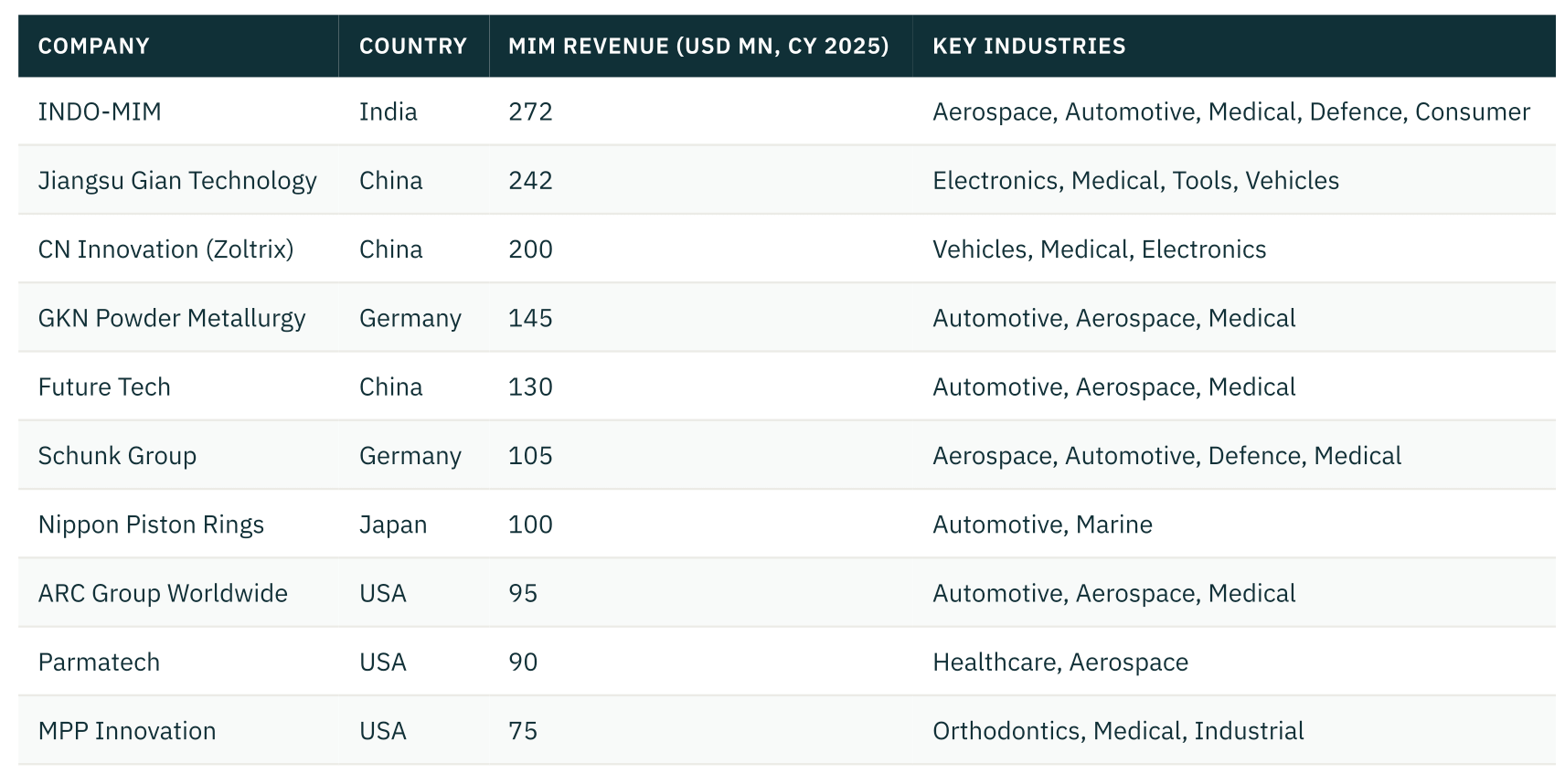
Jiangsu Gian is the closest competitor at USD 242 million, publicly listed on a Chinese exchange with 5,001-10,000 employees and two manufacturing sites in Changzhou and Dongguan. Its revenue grew 34.8% in CY 2025, outpacing Indo-MIM’s 25.9% growth in the same year, though from a lower base. Gian’s EBITDA margin of 14.7% is roughly 11 percentage points below Indo-MIM’s 25.5%.
CN Innovation (Zoltrix Material International) traces its MIM origins to watch components in 1990 and operates 250 injection molding machines with 9 continuous sintering furnaces from Guangzhou. GKN Powder Metallurgy, the fourth-largest at USD 145 million, operates over 30 global locations with 5,001-10,000 employees but is traditionally tied to automotive and carries a 9.1% EBITDA margin. Schunk Group, a private German company founded in 1913, holds USD 105 million in MIM revenue with three production facilities in Germany and Mexico and is the only manufacturer offering two-material 2C MIM components in serial production.
Financial benchmarking against Jiangsu Gian
The F&S report provides three-year financial benchmarks for Indo-MIM and Jiangsu Gian, the only two competitors with full KPI disclosure. The gap is wide.
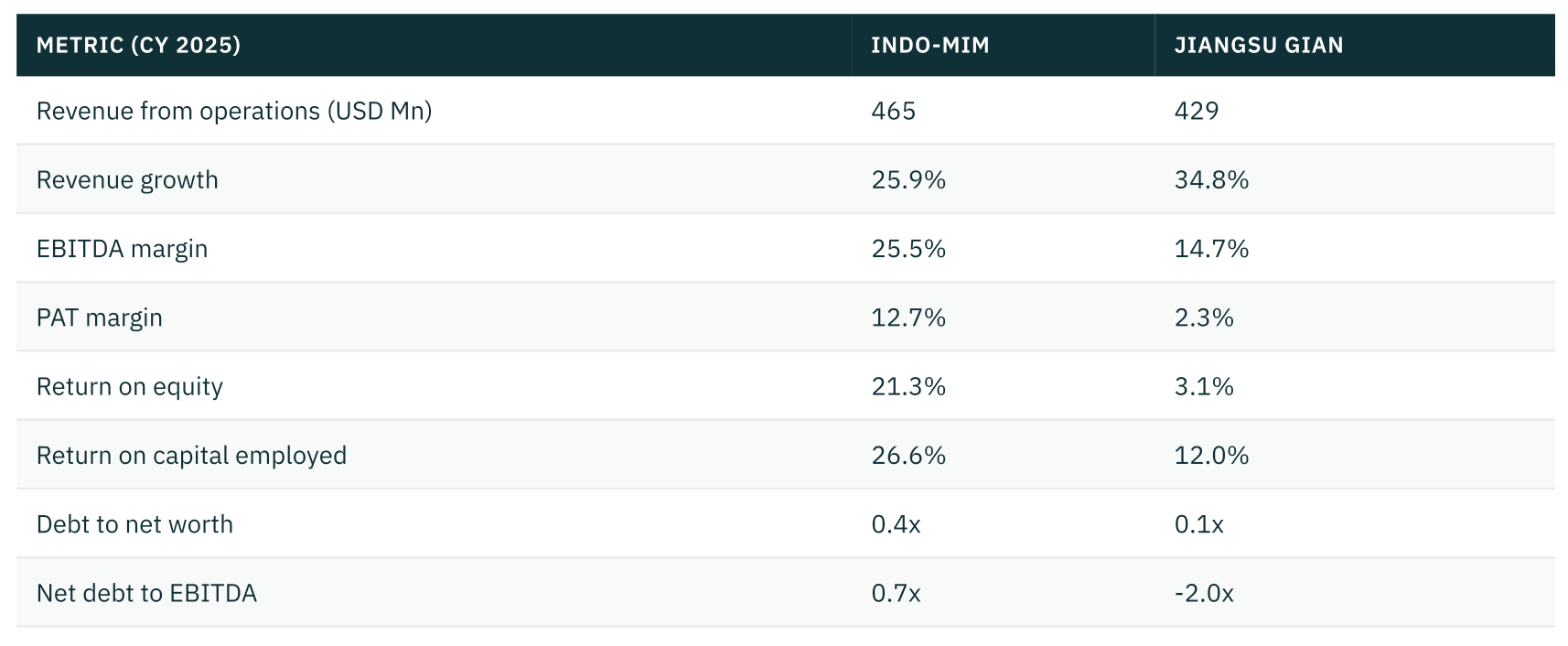
Indo-MIM carries higher debt (0.4x debt-to-net-worth versus Gian’s 0.1x) but generates substantially superior returns. Gian’s net cash position (negative net debt) contrasts with Indo-MIM’s Rs 12,123.49 million in outstanding borrowings as of May 31, 2026. The margin differential - 1,080 basis points at the EBITDA level - is the single most striking competitive datum in the commissioned report.
Market structure and fragmentation
The market is structurally fragmented. The top 10 manufacturers hold 37% share, the top 15 hold 40-45%, and international mid-size firms such as Kinetics, Phillips Medisize, Dynacast Portland, Porite, ATMIX, AMT, and Uneec collectively account for less than 30% of global MIM revenue. The long tail of small producers, particularly in mainland China, serves consumer electronics applications concentrated in the Zhujiang Delta industrial zone near Huawei, Lenovo, Apple, and Samsung.
Regional demand patterns differ sharply. China’s MIM production is driven by consumer electronics - smartphone casings, camera parts, laptop hinges, and connectors. North American MIM demand is concentrated in dental, orthodontic, and firearms applications. European demand skews toward automotive and consumer goods. Indo-MIM’s revenue mix, with defence at 18.69% and medical at 18.08% in FY 2026, positions it in different end-markets than the Chinese concentration in consumer electronics.
Entry barriers and the single-source dynamic
The F&S report identifies several structural barriers that protect incumbent positions:
Capital intensity. Setting up MIM plants requires specialized equipment for molds, inspection systems, and material handling. Injection molds cost USD 10,000 to USD 100,000 depending on part complexity, and MIM is economical only at production volumes above 100,000 units.
Supplier qualification cycles. The onboarding process takes 2-3 years, involving supplier audits, testing, trial runs, periodic reviews, and inspections of procurement, manufacturing, and logistics capabilities. Indo-MIM’s top customer relationships span 17 years (Customer 1 in DPG and Customer 3 in MPG, both since Fiscal 2010).
Single-sourcing economics. Precision components are typically sourced from a single supplier because dedicated tooling costs and validation burdens make dual-sourcing economically unattractive. This is especially true in aerospace and medical, where volumes are too low to justify qualifying a second vendor. Automotive and consumer electronics, with higher volumes, can support multi-vendor strategies.
Technical and metallurgical know-how. Feedstock formulation, tooling design, sintering process control, and shrinkage management require specialized expertise. The F&S report identifies a shortage of experienced MIM engineers as an industry-wide constraint, with a steep learning curve for new entrants.
The single-source dynamic is the most important structural feature. Once an OEM qualifies a MIM supplier and invests in dedicated tooling, switching costs are prohibitive for low-to-medium volume parts. This explains the 91.6% repeat customer revenue rate Indo-MIM reported in FY 2026, and it means the competitive set is largely fixed - displacement requires either a new program launch where an incumbent fails to qualify, or an acquisition.
The F&S projections against Indo-MIM’s own history
The F&S report projects the global MIM market growing at 9.2% CAGR through CY 2030, with India specifically at 10.3%. Indo-MIM’s own revenue growth has been 25.93% in FY 2026 and 16.00% in FY 2025 - well above the projected market rate. This suggests Indo-MIM is gaining share, but it also means the commissioned forecast implies a significant deceleration from the company’s recent growth trajectory. The medical devices segment is projected to grow at 11.6% CAGR and aerospace at 9.2%, which are the two fastest-growing end-markets in the forecast and together account for 30.04% of Indo-MIM’s FY 2026 revenue.
The report also flags substitution risk from metal 3D printing, which is projected to grow at 22.3% CAGR from USD 23 billion to USD 63 billion between 2025 and 2030. The F&S report frames 3D printing as complementary to MIM for prototyping rather than competitive for volume production, but the technology is eroding MIM’s advantage in low-to-medium volume applications where tooling costs are hardest to amortize.
Capacity, utilisation, and growth drivers
Installed capacity and utilisation by technology
The offer document discloses capacity figures for three of Indo-MIM’s five manufacturing technologies. Ceramic injection molding and metal 3D printing are excluded from the capacity table because they serve in-house requirements, and the company states it cannot break out capacity by end-use product group because production lines are fungible across automotive, defence, medical, consumer, and aerospace parts.
Capacity is certified by an independent chartered engineer based on 353 working days per year, three shifts per day, and 21 hours per day of operation. Installed capacity equals available capacity across all three disclosed technologies, meaning the company reports no downtime for scheduled maintenance or retooling in its capacity calculation.
MIM technology is the core platform, spanning four facilities: Hoskote and Doddaballapur in India, Indo-MIM Inc. in San Antonio (Texas), and Conway Marsh Garrett Technologies in the UK. Combined installed capacity in FY2026 was 874.56 million parts, against actual production of 267.42 million parts - a utilisation rate of 30.58%. This is a decline from 35.76% in FY2025 and 27.66% in FY2024. The Doddaballapur facility accounts for roughly 79% of total MIM installed capacity (693.59 million parts) and is the single largest production site. The UK facility is the smallest at 12.20 million parts and ran at just 16.74% utilisation in FY2026.
The drop in MIM utilisation from 35.76% to 30.58% occurred despite revenue growing 25.93% in FY2026. This means the company added capacity faster than it filled it. Installed MIM capacity rose from 850.77 million parts in FY2025 to 874.56 million in FY2026, while actual production fell from 304.22 million parts to 267.42 million. The San Antonio facility saw the steepest production decline, from 18.55 million parts in FY2025 to 15.47 million in FY2026, with utilisation dropping from 34.09% to 25.99%.
Precision machining operates from a single line at Doddaballapur. Installed capacity was 1.41 million parts in FY2026 with actual production of 0.77 million parts, yielding 54.75% utilisation. This is down from 57.52% in FY2025 but up from 62.79% in FY2024 - though the installed capacity itself expanded from 0.86 million parts in FY2024 to 1.41 million in FY2026, a 64% increase over two years.
Investment casting runs across two facilities: Tirupati in India (the larger operation) and Triax Industries in Chandler, Arizona. Combined installed capacity was 20.16 million parts in FY2026 against production of 11.80 million, for 58.55% utilisation. The Tirupati facility operated at 59.85% utilisation, down sharply from 71.30% in FY2025 and 76.98% in FY2024. Triax ran at just 9.25% utilisation, producing 0.05 million parts against 0.52 million capacity - and this figure has been below 10% for three consecutive years. The Tirupati facility saw its installed capacity expanded from 12.47 million parts in FY2024 to 19.64 million in FY2026, a 57% increase, even as utilisation fell from 76.98% to 59.85%.
What the capacity numbers tell you
The picture is one of aggressive capacity addition ahead of demand. Across the three disclosed technologies, total installed capacity reached 896.13 million parts in FY2026, but actual production was 279.99 million parts - a blended utilisation of roughly 31%. The company has grown its installed base meaningfully over three years while utilisation has declined or stayed flat in every technology except precision machining (where it rose year-on-year in FY2026 off a very small base).
The company itself flags this as a risk factor. The low utilisation means significant fixed costs are being absorbed by a smaller production volume than the capacity implies. The counterargument is that MIM components are dedicated to specific customer programs - each new product requires its own tooling, and the 2-3 year supplier onboarding cycle means capacity must be built ahead of committed demand. The 91.6% repeat customer revenue base provides some visibility that existing tools will continue generating orders, but the gap between installed and utilised capacity is wide.
Growth drivers: how they relate
The company’s growth initiatives fall into three categories that serve different strategic purposes.
Backward integration - the Gowribidanur iron powder plant and the existing stainless-steel powder manufacturing at Doddaballapur - attacks raw material cost and supply security. With 60.95% of raw materials imported in FY2026 and metal powders alone accounting for Rs 1,562.34 million of purchases (17.85% of total raw material cost), producing iron powder domestically directly substitutes import dependence. This is the most immediately actionable driver: the land is leased from KIADB, the facility is under construction, and the company targets commissioning by end of FY2027.
Capacity and capability expansion - the Tamil Nadu tool room and machining unit, the INDO-MIM Arms Components subsidiary, and the potential European MIM acquisition - adds production capacity and geographic reach. The Tamil Nadu facility at SIPCOT Industrial Park, Sriperumbudur, is leased through June 2121 and is already under construction. INDO-MIM Arms Components was incorporated on December 5, 2025, with an authorised capital of Rs 30 million, but has no disclosed operations yet. The European acquisition is stated intent with no identified target.
New market entry - the INDO Flex joint venture with AUFLEX Co. Ltd. of South Korea for foldable hinge modules - represents a step beyond Indo-MIM’s current product portfolio into assembled mechanical modules for consumer electronics. The JV agreement was signed on November 30, 2024, with a proposed initial registered capital of Rs 100 million and a 49:51 shareholding split (Indo-MIM 49%, AUFLEX 51%). AUFLEX will receive an annual or half-yearly licence fee for the hinge technology and IP. This is the driver with the highest optionality but also the highest execution risk: Indo-MIM is the minority partner, the technology is licensed rather than owned, and foldable hinge modules compete in a market dominated by existing Asian supply chains.
The defence and medical segment opportunities are demand-side drivers rather than discrete capex projects. Defence revenue actually declined from 26.80% of revenue in FY2025 to 18.69% in FY2026, even as the company highlights increased FDI limits and Make in India initiatives. Medical revenue grew from Rs 5,773.04 million to Rs 7,579.82 million (31.3% growth), making it the fastest-growing segment. The F&S report commissioned for the offer estimates MIM demand in medical devices growing at 11.6% CAGR through 2030, the highest among the end-use segments tracked.
The driver that matters most for near-term earnings is the Gowribidanur iron powder plant, because it directly reduces the cost of the single largest imported raw material category and has a concrete commissioning timeline. The Tamil Nadu facility matters most for medium-term capacity, because tool room and machining capabilities are the bottleneck for new product introduction - the company currently produces 45-50 new tools per month, and expanding this throughput directly accelerates customer onboarding. The INDO Flex JV and the European acquisition are longer-dated options that depend on execution not yet visible in the financials.
Iron powder manufacturing facility at Gowribidanur
INDO-MIM is setting up an iron powder manufacturing facility at Gowribidanur Industrial Area, Chikkaballapur, Karnataka. This is a backward integration play: iron powder (specifically carbonyl iron powder) is a primary raw material for MIM feedstock, and the company currently imports a significant portion of its metal powders. In Fiscal 2026, metal powders sourced from outside India cost ₹1,482.19 million, representing 16.95% of total raw material purchases. Producing iron powder in-house is intended to reduce import dependence, capture the supplier margin internally, and insulate costs from global commodity price movements and currency fluctuations.
What is built versus what is intent:
Built and contracted. The land is secured. The company has leased the parcel from Karnataka Industrial Areas Development Board (KIADB), with the lease valid till February 3, 2120. Capital expenditure at this site is already underway and bank-financed. Three separate term loans (from Kotak Mahindra Bank, Axis Bank, and IDFC FIRST Bank) list “Powder plant unit, Gowribidanur” as an earmarked capex line item, with combined sanctioned utilisation of approximately ₹677.70 million drawn against this specific unit across those facilities. The Doddaballapura facility already houses metal powder manufacturing for stainless steel, so the company has operating experience in powder production.
Stated as intent. The company states it is “in the process of setting up” the facility and targets commissioning “by end of Fiscal 2027.” No installed capacity, production volume, or revenue figure for the Gowribidanur facility is disclosed anywhere in the offer document. No contracted offtake agreements for iron powder from this plant are mentioned. The company does not disclose what percentage of its iron powder consumption the facility is designed to meet.
The mechanism to revenue is indirect. Iron powder produced here would substitute imported raw material rather than be sold as a finished product. The cost savings would flow through as lower material consumption costs (which were 20.87% of revenue in Fiscal 2026) and improved gross margins, rather than as a new revenue line. The “Others” category in the revenue mix, which includes sale of powder, tools and traded products, was 15.86% of revenue in Fiscal 2026, but the document does not break out how much of that is currently powder sales.
New tool room and machining unit in Tamil Nadu
INDO-MIM has leased a facility at SIPCOT Industrial Park, Vallam Vadagal, Sriperumbudur Taluk, Kancheepuram district, Tamil Nadu, described in the offer document as a “new unit for tool room and machining.” The lease, from State Industries Promotion Corporation of Tamil Nadu Limited, runs till June 1, 2121. The land area is 67,946.78 square metres with 15,050.00 square metres of building area.
This is the company’s sixth Indian manufacturing facility and is listed among its 15 core operating facilities as of the date of the RHP. The company states the unit is under construction. The RHP does not disclose a commissioning date, installed capacity, or capital expenditure specific to this facility.
The mechanism to revenue is straightforward. INDO-MIM currently produces 45 to 50 new tools per month and houses tooling capabilities at its Doddaballapura and Jala Hobli facilities in Bengaluru. A dedicated Tamil Nadu unit adds capacity for mold design, tooling, and precision machining, which are the upstream processes required before MIM or investment casting production begins. More tool room capacity means the company can develop and deliver new tools faster, shortening the lead time to qualify new components with OEM customers and move them into serial production.
What is built: The lease is signed and the facility is listed as an operating manufacturing unit. Bank loan sanctions from Kotak Mahindra Bank (₹28.80 million), Axis Bank (₹196.01 million), HDFC Bank (₹190.34 million), and IDFC First Bank (₹208.18 million) confirm that capital expenditure has been incurred at this site across multiple tranches between Fiscal 2022 and Fiscal 2024.
What is not disclosed: The RHP provides no capacity figures, no utilisation data, and no revenue attribution for this unit. The capacity tables in the offer document cover MIM, precision machining, and investment casting at Hoskote, Doddaballapura, Tirupati, and the US and UK facilities, but the Tamil Nadu unit does not appear in them. The company states it is under construction, so production appears to be at an early stage or not yet commenced.
Joint venture for foldable hinge modules
INDO-MIM and AUFLEX Co. Ltd. (South Korea) signed a joint venture agreement on November 30, 2024 to set up INDO Flex Precision Private Limited. The JV is intended to manufacture and sell foldable hinge modules in India and other mutually agreed locations.
The revenue mechanism is straightforward: INDO Flex would produce hinge modules for foldable devices and sell them to OEMs. AUFLEX contributes the technology and intellectual property for the hinges, and INDO Flex would pay AUFLEX a license fee annually or half-yearly for that technology. INDO-MIM brings manufacturing scale and its existing customer relationships.
Everything about this driver is stated intent. The JV agreement is signed, but INDO Flex is not yet incorporated. The agreement contemplated establishment “within six months after the conclusion of the JV Agreement, or as may be mutually decided” - meaning the original six-month window has already elapsed. The offer document does not disclose whether the entity has been incorporated, whether any manufacturing facility has been identified or leased, or whether any customer has been contracted.
The proposed initial registered capital is ₹100 million, with INDO-MIM holding 49% and AUFLEX holding 51%. AUFLEX would hold majority control of the JV. The offer document discloses no capex commitments, no commissioning timeline, no capacity targets, and no contracted orders for foldable hinge modules.
This is a pre-revenue concept. Foldable hinge modules are a new product category for INDO-MIM, distinct from its existing MIM components for consumer electronics (currently classified under CPG, which contributed 10.80% of revenue in Fiscal 2026). The company has no track record manufacturing hinge assemblies, and AUFLEX’s technology and customer base are not described in the offer document beyond the license-fee arrangement. Whether this JV produces revenue depends entirely on execution that has not yet begun.
New subsidiary for engineering metal parts
INDO-MIM Arms Components Private Limited was incorporated on December 5, 2025 as a wholly-owned subsidiary. The RHP states its authorised business is “manufacturing of engineering metal parts.” The subsidiary has authorised share capital of ₹30 million and paid-up capital of ₹10 million. INDO-MIM holds 999,999 of 1,000,000 equity shares; the remaining one share is held by a KMP as nominee.
That is the full extent of what is built. The subsidiary exists as a legal entity with capital subscribed. The offer document discloses no manufacturing facility, no equipment, no land or lease, no customer contracts, and no employees attached to it. The RHP does not describe a specific product line, target end-use industry, or technology it will use. The name suggests a defence-arms focus, but the stated business scope is generic “engineering metal parts” and the document does not narrow it further.
The mechanism by which this turns into revenue would be the same as INDO-MIM’s existing model: set up production capacity, qualify with OEM customers through their 2-to-3-year supplier audit process, and supply precision components on purchase orders. None of those steps has been disclosed as started for this subsidiary.
The company’s strategy section says it will “focus on growing our operations by capitalizing on the increasing number of opportunities in the defence industry,” and separately lists the subsidiary’s incorporation as a fact. The RHP does not state a commissioning date, capex budget, or revenue timeline for INDO-MIM Arms. An investor should treat this as a shell entity with stated intent to manufacture, with no operating assets or contracted revenue today.
Potential MIM technology acquisition in Europe
This is stated intent, not a plan in execution. The offer document contains a single sentence on the subject:
“We may consider an acquisition of an entity manufacturing products using MIM technology in Europe to expand our business, provided such acquisition offers the synergies that we look for and are available at competitive prices.”
RHP, Our Business
There is no target identified, no term sheet, no valuation range, no committed capital, and no timeline. The company lists selection criteria it intends to apply - management quality, operational scale, technological capability, customer base, end-market exposure, and cultural fit - but these are preferences, not constraints tied to a live process.
The mechanism by which a European MIM acquisition would turn into revenue is straightforward: INDO-MIM already has a European manufacturing presence through its UK subsidiary Conway Marsh Garrett Technologies Limited (”CMG”), acquired for £10.53 million. CMG operates two facilities in Rendlesham with installed MIM capacity of 12.20 million parts as of Fiscal 2026, running at 16.74% utilisation. A further European acquisition would add MIM capacity on the continent, potentially bringing new European OEM customers and localising supply for existing ones. Europe contributed ₹8,372.88 million, or 19.97% of revenue from operations, in Fiscal 2026.
The company’s track record on acquisitions is real and disclosed. Beyond CMG, it acquired Triax Industries in the US for USD 12.50 million (investment casting, aerospace) and Phoenix DeVentures II in the US for USD 15.80 million (medical device design and development). Term loan disclosures show ₹1,100 million was deployed specifically to align CMG’s MIM processes with INDO-MIM’s standards and transfer Indian tooling and product engineering capabilities to the UK facility.
That track record demonstrates the company can identify, fund, and integrate MIM-adjacent businesses. It does not make the European acquisition itself any more than a possibility the board has taken on record.
2K MIM technology and MIM copper material development
The company describes two material and process initiatives in its strategy section, both at the exploratory stage.
2K MIM technology molds two different MIM materials together in a single process, producing a single component with distinct material properties in different regions. The company states this would “enable us to produce components with different features” and provide “greater flexibility in product development.” The revenue mechanism is the same as existing MIM parts: the company would manufacture and sell these multi-material components to OEMs, likely at a premium to single-material MIM parts given the reduced assembly requirement. The company currently offers over 80 alloying options and produces 45 to 50 new tools per month, so the molding infrastructure exists. What does not exist is any disclosed investment in 2K-specific equipment, a timeline for development, or a contracted customer for 2K parts.
The second initiative is developing MIM copper material that matches the properties of wrought copper. The company states it “aims to develop” this material to serve “industries that require high-performance copper components.” No target industries are named, no capex is allocated, and no customer has contracted for MIM copper parts. The offer document does not disclose any R&D budget, pilot production runs, or material property test results.
Both initiatives appear under the strategy heading “Retain and strengthen our technological leadership through continued focus on engineering capabilities,” alongside a third exploratory item on sacrificial plastic material in MIM molds. The language throughout is conditional: “we may also explore,” “we aim to develop,” “we are exploring.” None of these have allocated capital in the objects of the offer, which directs ₹4,000 million to debt repayment and the remainder to general corporate purposes. A pre-listing company has no track record of delivering on such stated intent, and the offer document provides no milestones, commissioning dates, or revenue projections for either initiative.
Financial track record
The restated consolidated financials cover three full years: fiscal 2024, fiscal 2025, and fiscal 2026 (all years ended March 31). All figures are in Rs. million unless stated otherwise.
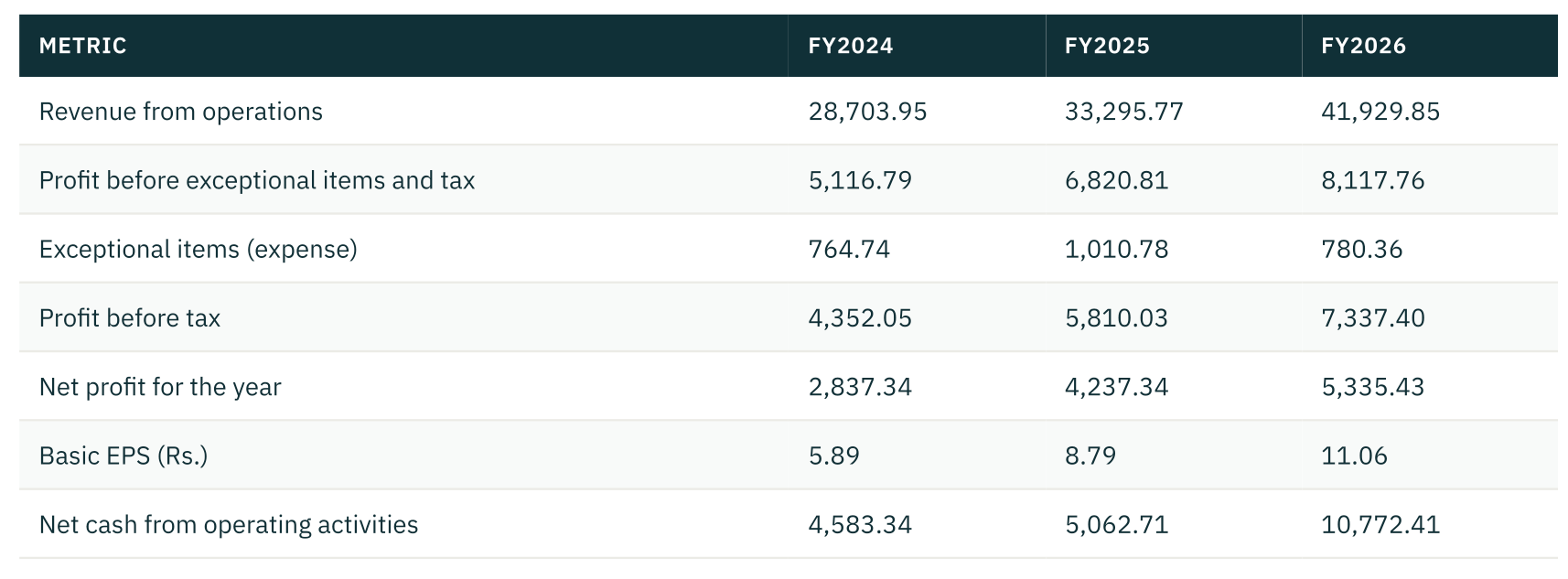
Revenue growth and what drove it
Revenue grew 16% in FY2025 and another 26% in FY2026, reaching Rs. 41,929.85 million. The business is overwhelmingly export-oriented: Rs. 32,369.73 million of FY2026 revenue came from outside India versus Rs. 9,040.83 million from India. The India revenue line itself jumped from Rs. 2,845.35 million in FY2025 to Rs. 9,040.83 million in FY2026, a threefold increase that likely reflects new domestic capacity coming online or a shift in customer mix. Product sales dominate at Rs. 39,428.47 million in FY2026, with tooling income (Rs. 1,209.05 million) and services (Rs. 773.04 million) making up the balance.
Other income rose sharply to Rs. 1,277.17 million in FY2026 from Rs. 443.95 million a year earlier. Two items explain most of this: Rs. 368.65 million in compensation received from customers on cancellation of contracts, and Rs. 802.17 million in net foreign exchange gain. The forex gain is partly a natural consequence of the rupee’s movement against the dollar on a large export book, but it is non-operating and inflates total income.
Exceptional items: recurring impairments
Exceptional items have hit the P&L in all three years, and they are entirely driven by impairment charges on two acquired subsidiaries.
In FY2024, the company recognised Rs. 539.47 million of goodwill impairment on Triax Industries (aerospace and industrial gas turbine components, USA) and Rs. 225.27 million of PPE impairment there. In FY2025, Triax PPE was further impaired by Rs. 1,031.13 million, and Conway Marsh Garrett Technologies (MIM components, UK) took a Rs. 120.43 million goodwill impairment. In FY2026, Conway Marsh absorbed Rs. 711.28 million of goodwill impairment plus Rs. 96.40 million of PPE and right-of-use asset impairment, while Triax had a Rs. 27.32 million reversal of PPE impairment.
The total exceptional charges over three years amount to Rs. 2,555.88 million. Conway Marsh was acquired in July 2023 for a total consideration of Rs. 1,036.19 million (discounted), of which Rs. 831.71 million was goodwill. By March 2026, Rs. 659.90 million of that goodwill has been impaired. Phoenix De Ventures II, Inc. (medical device development, USA) was acquired in May 2025 for Rs. 1,254.05 million (discounted), creating Rs. 1,128.33 million of goodwill, against which no impairment has been recognised yet.
Quality of earnings: does profit convert to cash?
Operating cash flow has been strong and has consistently exceeded reported profit. In FY2026, net cash from operating activities was Rs. 10,772.41 million against a net profit of Rs. 5,335.43 million. In FY2025, operating cash flow was Rs. 5,062.71 million against a profit of Rs. 4,237.34 million. In FY2024, the figures were Rs. 4,583.34 million and Rs. 2,837.34 million.
The gap between operating cash flow and profit is driven by the exceptional impairment charges (which are non-cash) and by depreciation. In FY2026, the cash flow statement adds back Rs. 2,200.64 million of depreciation and Rs. 780.36 million of exceptional items. The large impairment charges that depress reported profit are non-cash accounting recognitions.
Working capital: where the growth cash is going
Working capital absorption is the main quality-of-earnings concern, and it is concentrated in FY2025.
Trade receivables grew from Rs. 5,542.43 million in March 2024 to Rs. 6,438.20 million in March 2025 to Rs. 7,637.87 million in March 2026. The year-on-year increase in FY2026 was Rs. 1,199.67 million, and in FY2025 it was Rs. 895.77 million. Receivables are growing roughly in line with revenue, which is expected for a business with 77% export revenue and credit terms of 7 to 120 days. The receivables ageing is clean: of the Rs. 7,637.87 million outstanding at March 2026, Rs. 5,352.07 million is not yet due and Rs. 2,270.35 million is less than six months overdue. The credit-impaired balance is only Rs. 96.31 million.
Inventory is the bigger drag. Inventories stood at Rs. 6,768.93 million in March 2024, jumped to Rs. 8,991.56 million in March 2025 (an increase of Rs. 2,222.63 million), and then were almost flat at Rs. 8,949.85 million in March 2026. The FY2025 inventory build absorbed Rs. 2,222.63 million of cash, which is why operating cash flow that year (Rs. 5,062.71 million) was only modestly above profit despite large non-cash add-backs. Raw materials alone went from Rs. 2,934.97 million to Rs. 4,100.12 million in FY2025, reflecting the scale-up. Work-in-progress is the largest inventory line at Rs. 4,164.97 million in March 2026, consistent with a multi-process manufacturing operation (MIM, investment casting, precision machining).
In FY2026, inventory was essentially flat (a Rs. 41.71 million decrease), which is why operating cash flow surged to Rs. 10,772.41 million. The working capital machine paused, and the profit flowed through to cash.
Debt position
Total borrowings (current and non-current, excluding lease liabilities) moved as follows:

Net debt (borrowings minus cash and cash equivalents) was Rs. 8,521.55 million in March 2024, Rs. 10,725.76 million in March 2025, and Rs. 7,009.26 million in March 2026. The company repaid Rs. 1,899.20 million of net borrowings in FY2026, funded by the surge in operating cash flow. The cash balance rose from Rs. 1,746.19 million to Rs. 3,895.62 million in the same period.
Borrowings are a mix of rupee term loans (interest 6.73% to 11.85%), foreign currency term loans (USD 5.58%-6.43%, EUR 2.80%), and working capital facilities (cash credit at 8.50%-9.50%). All are secured by first pari-passu charges on fixed assets and second charges on current assets. The contingent consideration payable for the Phoenix De Ventures acquisition (Rs. 760.00 million, due May 2027) sits as a separate non-current financial liability.
Finance costs rose from Rs. 874.06 million in FY2024 to Rs. 961.02 million in FY2025 to Rs. 1,668.00 million in FY2026. The FY2026 jump is partly from Rs. 482.88 million of exchange differences on foreign currency borrowings treated as borrowing cost adjustments, up from Rs. (32.41) million in FY2025.
Key risks
No binding customer contracts. The company does business entirely on a purchase-order basis. Even where purchase and supply agreements exist, they set terms of sale but commit no volumes, no duration, and no exclusivity. Customers can cancel, delay, or shift production to another supplier without penalty. Because MIM tooling is dedicated and single-sourced, the switching cost protects Indo-MIM while the program runs - but the moment a customer redesigns a part, changes manufacturing strategy, or re-sources, revenue from that program drops to zero with no contractual recourse. The 91.6% repeat-customer rate in FY2026 reflects the economics of staying, not a contractual obligation to stay.
Export concentration and US tariff exposure. North America alone is 43.68% of revenue (Rs 18,316.45 million in FY2026). The RHP explicitly flags the US government’s “Fair and Reciprocal Plan” and the August 2025 increase in import duties on Indian automotive components. If tariffs expand or escalate, Indo-MIM’s cost competitiveness in its largest single market erodes directly. The dual-shore model (six US facilities) partially mitigates this for customers requiring domestic US sourcing, but the India-based MIM production feeding US OEMs has no such shield. Europe is another 19.97% of revenue, and the RHP cites “plateauing electric vehicle adoption” and “inventory optimisation” by European and Japanese OEMs as near-term demand risks.
Raw material import dependence at 60.95%. Metal powders - carbonyl iron powder, stainless steel powder - and polymers are the core feedstock. In FY2026, Rs 5,329.96 million of raw materials came from outside India, sourced from China, Japan, the UK, Germany, and France. The Gowribidanur iron powder facility (targeted for end of Fiscal 2027) is a backward-integration step, but until it is operational, any supply disruption, import restriction under the Hazardous Chemical Rules, or commodity price spike flows straight into cost of materials, which already rose from 15.68% of revenue in FY2024 to 20.87% in FY2026. The company has no long-term supply contracts with its suppliers - all procurement is on purchase order.
Customer concentration in the top 10. The top 10 customers contributed 38.41% of revenue in FY2026 (Rs 16,103.18 million). The top single customer is 7.97% (Rs 3,341.87 million). Seven of the top 10 are overseas customers. The top 5 includes a customer relationship that started in Fiscal 2024 and another that started in Fiscal 2026 - meaning the newest relationships are also among the largest, which cuts both ways. If any of these customers face their own demand contraction, plant shutdowns, or design changes, the impact on Indo-MIM’s revenue is disproportionate and immediate.
Key-person dependence on the Chivukula family. Krishna Chivukula (CMD, 30+ years in MIM) and Krishna Chivukula Jr. (CEO, with the company since 2004) are the central decision-makers. Both signed the financial statements from the US (Florida and New York, respectively), while the company is headquartered in Bengaluru. The CMD was previously disqualified as a director from November 2016 to October 2021 under Section 164(2)(a) of the Companies Act due to non-compliance at Shiva Chem Technologies, a company struck off by RoC Hyderabad. His DIN was reactivated by High Court order. There is no succession plan disclosed.
Five subsidiaries not audited by the principal auditor. The statutory auditor did not audit the financial statements of five subsidiaries - four of which are outside India. These subsidiaries reflect total assets of Rs 15,788.77 million and total revenues of Rs 7,108.78 million for FY2026. That is 17% of consolidated revenue sitting in entities whose financials the principal auditor relied on from other auditors’ reports. Indo-MIM Mexico has no mandatory audit requirement under local law, meaning its financials may not be audited at all.
Exceptional items recurring every year. Exceptional items charged to profit before tax were Rs 780.36 million in FY2026, Rs 1,010.78 million in FY2025, and Rs 764.74 million in FY2024. These are primarily impairment losses on Triax Industries (USA) and Conway Marsh Garrett Technologies (UK) - acquisitions that have not performed to expectations. Goodwill on acquisition of subsidiaries stands at Rs 1,128.33 million as of March 31, 2026, up from Rs 711.28 million in FY2025. The pattern of recurring impairments on acquired entities raises questions about the acquisition strategy and due diligence process.
Capacity utilisation declining despite revenue growth. MIM capacity utilisation dropped from 35.76% in FY2025 to 30.58% in FY2026, even as revenue grew 25.93%. This means the company is adding capacity faster than it is filling it. The under-construction Tamil Nadu facility and the Gowribidanur iron powder plant will add more. Low utilisation means fixed costs are spread over fewer units, pressuring margins - and the EBITDA margin did compress from 28.01% in FY2025 to 25.54% in FY2026.
Related-party transactions and promoter-group opacity. Absolute related-party transactions were Rs 2,551.56 million in FY2026 (6.09% of revenue). The company acquired 18.31% in Avaada KNSolar (Rs 71.03 million) and 26% in FP Solar Shakti (Rs 26.60 million) under power purchase agreements with put/call options. A promoter-group member, Ravi Chandrasekhar (son of promoter Jagadamba Chandrasekhar), has been unreachable for 20 years, and SEBI rejected the company’s application for exemption from disclosing him. His disclosures are based solely on public-domain information the company has not verified. The company also leases properties to Shiva Analyticals, an entity connected to the promoters.
Cost-audit show cause notices. The MCA issued two show cause notices (August 2024 and October 2024) to the company, its promoters, and directors for failing to appoint a cost auditor for FY2022, FY2023, and FY2024. The company claims exemption because export turnover exceeded 75% of total turnover. The matter is pending. If the MCA rejects the exemption claim, the company and its officers face compounding proceedings.
Indo-MIM Mexico’s unusual ownership structure. The Mexican subsidiary is 51% owned by Eduardo David Garcia (a non-related local individual) and 49% by Indo-MIM Inc. Despite holding the minority stake, the company accounts for it as a subsidiary because it “exercises significant control and bears substantially all risks of ownership/loss.” This structure means a majority of the economic risk sits with Indo-MIM while a majority of the legal ownership sits with an unrelated individual - a governance arrangement that is unusual for a subsidiary and could create complications in disputes.
Valuation Model
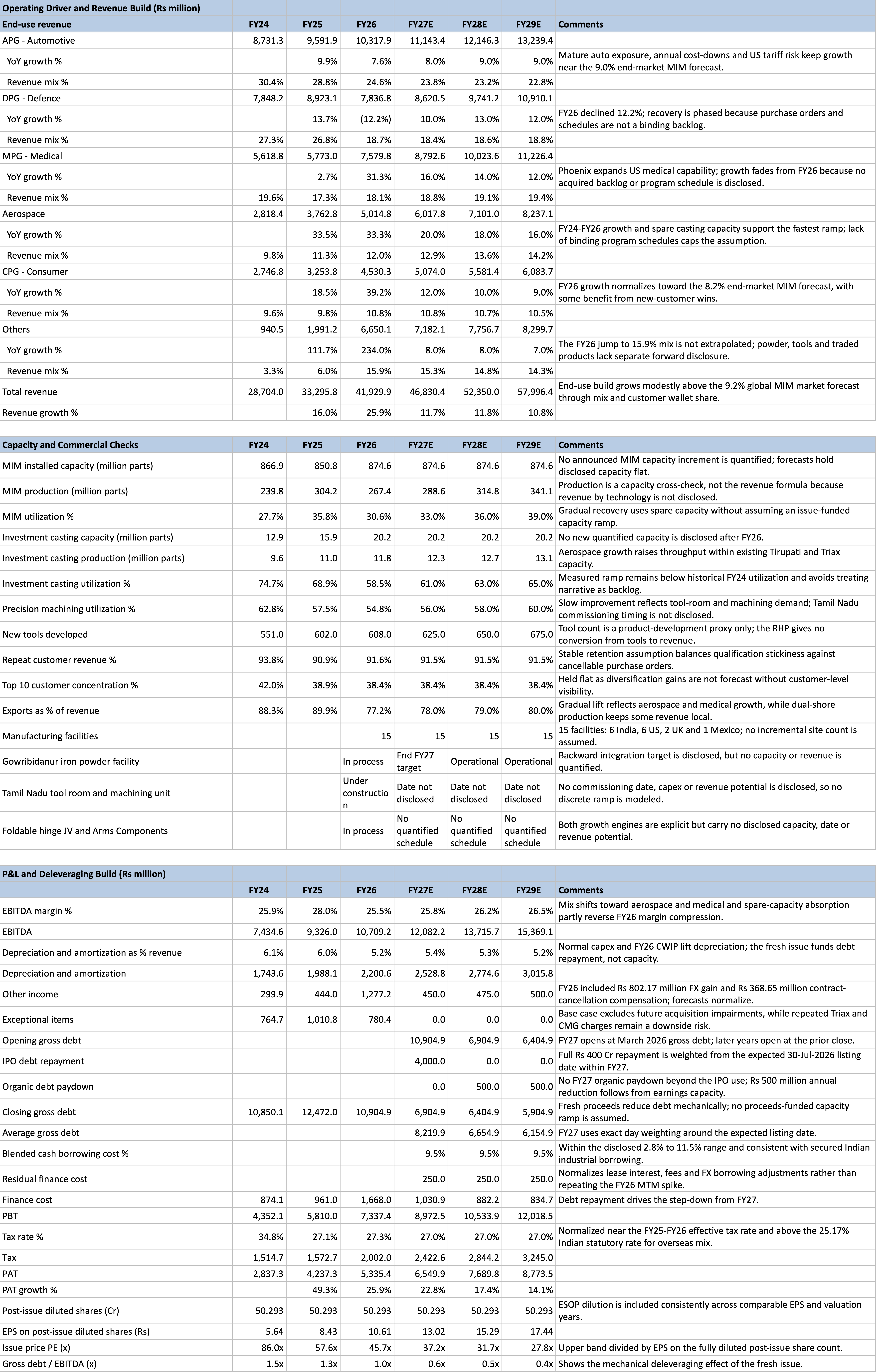
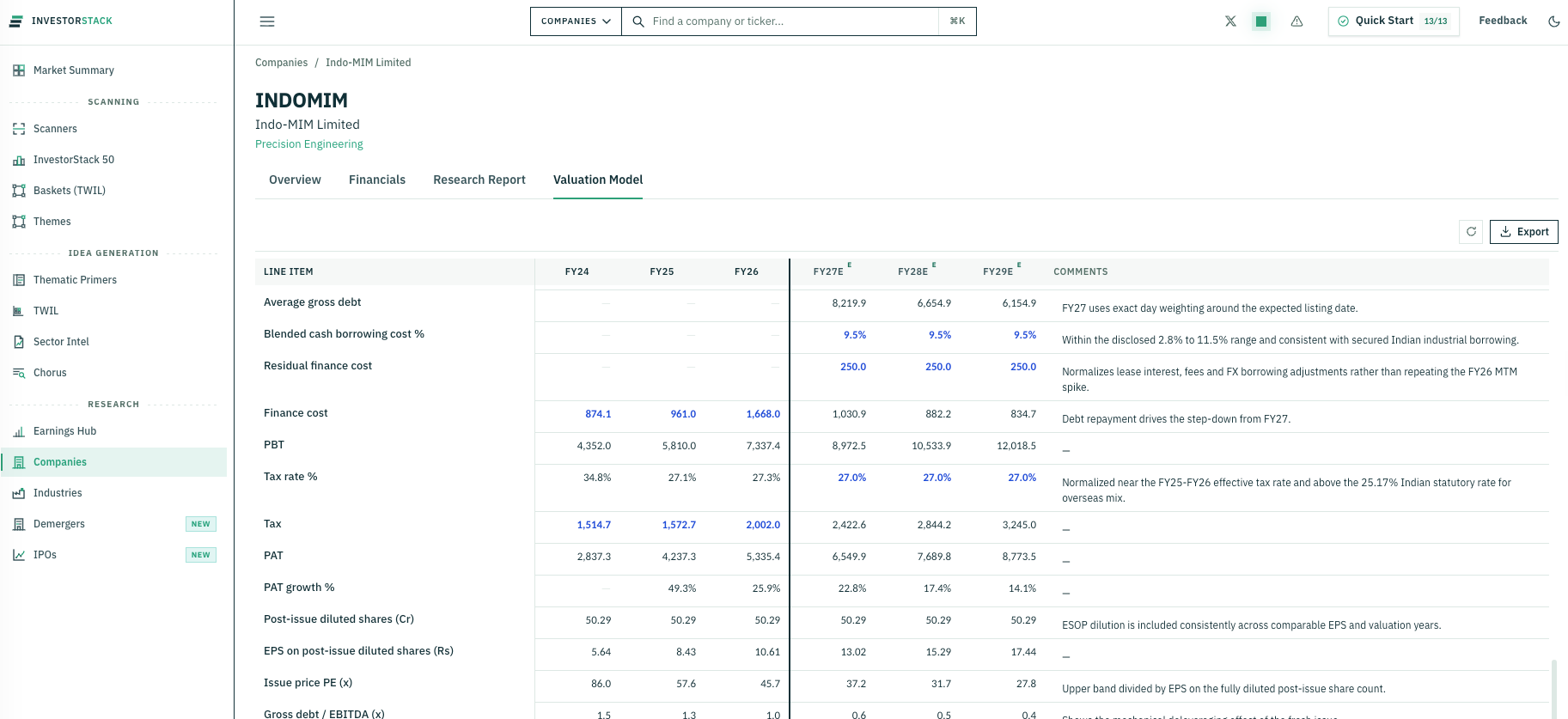
Investorstack subscribers can open the company’s page and export the valuation model. To get access to research reports and models for Indian listed companies and upcoming IPOs, join Investorstack.