
Sona BLW Precision Forgings
From precision forging to physical AI and robotics
Before we begin, Investorstack is now free to try. Research reports, valuation models, scanners, thematic baskets, industry reports, One pagers. All under one subscription.
Sona Comstar designs and manufactures precision-engineered, mission-critical mobility systems and components for global OEMs. The company started in 1995 as Sona Okegawa Precision Forgings, a joint venture between the Sona Group and Mitsubishi Materials, pioneering precision-formed bevel gears in India. It later acquired ThyssenKrupp’s precision forging business, BLW, which originally invented this technology. In 2019, it acquired Comstar Automotive, forming the Sona Comstar brand and entering the motor business. It listed on Indian exchanges in 2021. The company operates 12 manufacturing and assembly facilities across India, the USA, Mexico, China, Belgium, Serbia, and Germany, supported by 5 R&D centres and over 6,000 employees.
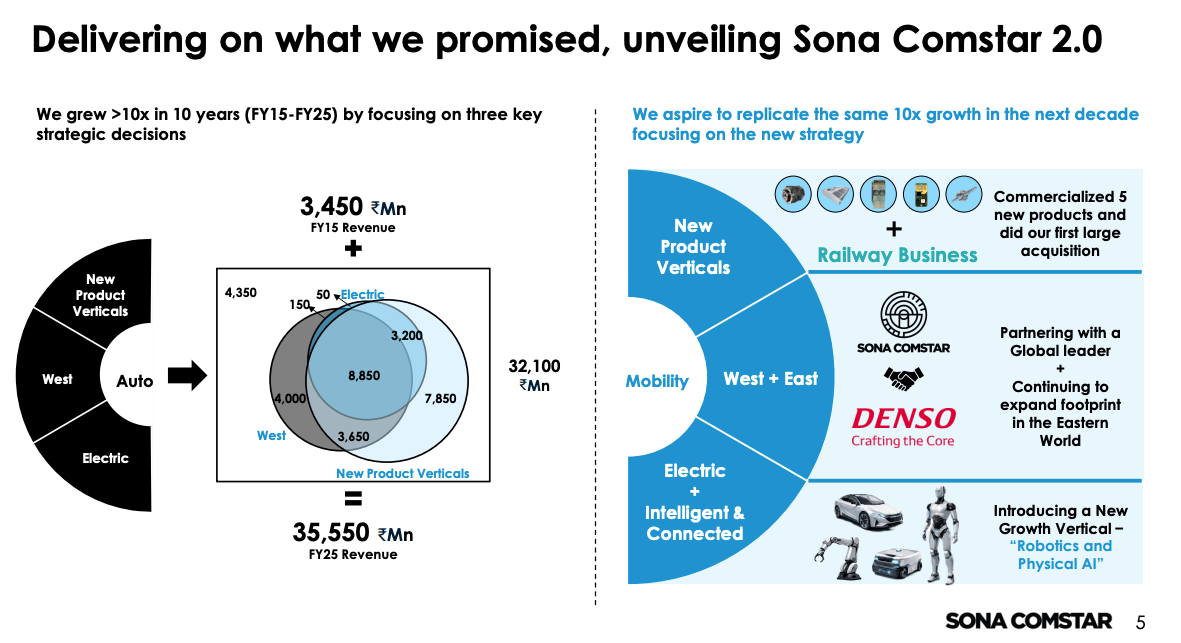
The company reports five operating segments.
Driveline Business
This segment designs and manufactures precision forged differential gears, differential assemblies, and other driveline components for conventional, hybrid, and electric vehicles. Differential gears and assemblies are the mechanical components that allow wheels to rotate at different speeds while distributing torque from the engine or motor. The core capability here is precision forging - a manufacturing process that produces high-strength gears with minimal material waste and tight tolerances. The company has crossed 500 million differential gears and 10 million differential assemblies manufactured since inception. Its global market share in differential gears stands at 8.7% in CY 2025, up from 4.5% in 2019. This is the legacy business that forms the foundation of the company. Differential assemblies contributed approximately 41% and differential gears approximately 9% of FY26 revenue. The segment serves passenger vehicles, commercial vehicles, and off-highway vehicles across India, North America, Europe, and China. The company supplies 7 of the world’s top-10 PV OEMs and 3 of the world’s top-10 CV OEMs. It is the largest supplier of EV differential assemblies in North America.
Motor Business
This segment produces starter motors, EV traction motors, suspension motors, and motor controllers. It also includes BLDC motor-based actuators for predictive active suspension systems. The motor business originated from the Comstar acquisition in 2019, which was a single-product starter motor company. Since then, the company has expanded it into multiple product lines. Starter motors serve both micro-hybrid and conventional ICE vehicles. EV traction motors are designed for electric 2-wheelers, 3-wheelers, and light commercial vehicles, using light rare earth or rare-earth-free ferrite-assisted synchronous reluctance technology. Suspension motors are BLDC motor and controller-based actuators for predictive active suspension systems, supplied to ClearMotion, which in turn supplies Nio and a European luxury performance OEM. The company has developed motors that do not use heavy rare earth magnets, which became critical after China stopped supplying heavy rare earth magnets to India in April 2025. Traction and suspension motors contributed approximately 11% and starter motors approximately 19% of FY26 revenue. The motor business serves electric 2-wheelers, 3-wheelers, passenger vehicles, commercial vehicles, and off-highway and farm equipment.
Railway Business
This segment designs and manufactures brake systems, couplers, suspension systems, friction products, HVAC, electric panels, and air springs for rolling stock. Sona Comstar acquired this business from Escorts Kubota in June 2025. The acquired business was a market leader in railway braking systems in India, with a product portfolio that included brake systems, couplers, dampers, and friction products. Post-acquisition, the company added air springs, automatic doors, HVAC systems, and electric control panels to the roadmap. During FY26, it commercialised railway HVAC systems and electric panels, and added air springs to the product roadmap. The railway business serves Indian Railways, metro rail networks, freight wagons, locomotives, and passenger coaches. Railway brake systems contributed approximately 7% and railway suspension and coupler approximately 22% of FY26 revenue. The business has an order book of INR 13 billion as of Q2 FY26, expected to be executed largely within 12 months.
Sensors and Software (NOVELIC)
Acquired in 2023, NOVELIC develops mmWave radar sensors, perception software, and engineering services for in-cabin and exterior ADAS applications. The company has set up a surface mount technology production facility in Chennai for radar sensor manufacturing. NOVELIC’s in-cabin radar product has been augmented with a vision system to address driver monitoring system mandates under AIS 184 regulation. Its 180-degree field-of-view exterior radar can replace up to 12 traditional ultrasonic sensors and 4 corner radars with just 4 radar sensors. This segment contributed approximately 1% of FY26 revenue. Production is commencing from FY27 onwards, with the exterior radar regulation mandate applying to M2/M3/N2/N3 vehicles in India.
Robotics and Physical AI
This is the newest vertical, announced in Q1 FY27. The company develops advanced components, subsystems, perception stacks, and full robotic platforms including AMRs and cobots. The logic is that the same technologies powering electric and autonomous vehicles - motors, gearboxes, actuators, sensors, electronics, and software - are the fundamental building blocks of intelligent machines. The company has secured INR 8 billion in order book across 3 orders: an advanced robotic subsystem, perception engineering services for AMRs, and a short-range radar perception solution for an Indian CV OEM. Start of production ranges from the current quarter to 15 months. The company showcased its first AMR prototype at CES 2026 in Las Vegas. It has an MoU with Neura Robotics of Germany for joint development of cognitive robotics, cobots, and humanoids. This segment is pre-revenue and not yet a meaningful contributor.
DENSO Joint Venture
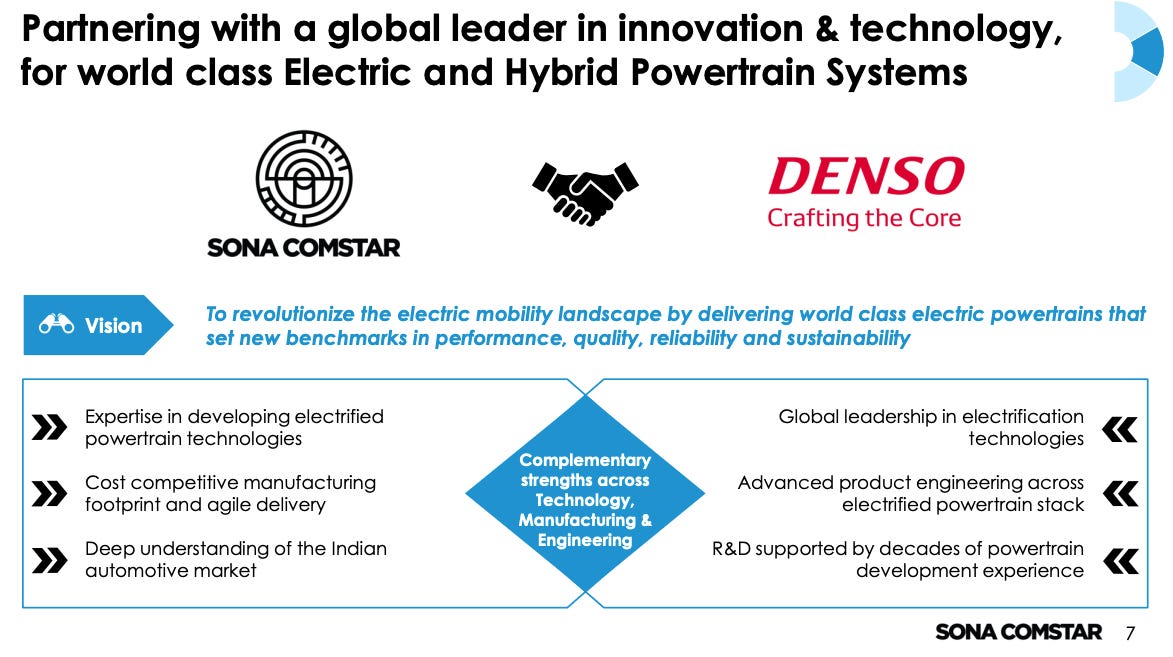
Announced in Q1 FY27, this partnership consists of two joint ventures. JV1 focuses on high voltage electric and hybrid powertrain systems for passenger and commercial vehicles, with DENSO holding majority stake and contributing technology. JV2 focuses on 2 and 3-wheeler traction motors, where Sona Comstar retains majority ownership and licenses its own technology into the venture. The royalty structure is reciprocal - JV2 pays royalties to DENSO for high voltage technologies, while JV1 pays royalties to Sona Comstar for its 2 and 3-wheeler technologies. This fills the company’s gap in high voltage electric and hybrid powertrain systems for 4-plus wheel vehicles. Phase I targets the Indian market, with Phase II planned for global expansion. The capex intensity is low - for every INR 1 crore of capex, the motor business can generate INR 8-9 crore of revenue, and high voltage systems can generate INR 11-12 crore. SOP timelines are confidential due to multiple party agreements.
Business segments
Driveline Business
Sona Comstar’s driveline business designs and manufactures precision forged differential gears, differential assemblies, and other driveline components for conventional, hybrid, and electric vehicles. The core capability is precision forging of bevel gears - a process the company inherited through its acquisition of ThyssenKrupp’s precision forging business (BLW), the original inventor of the technology. This is not a commodity machining operation. Vikram Verma, CEO of the Driveline Business, described the manufacturing challenge on the Q2 FY26 concall: forging has over 100 parameters affecting die life and quality, and the team spent more than a year collecting data to improve die life and raise gear quality by two ISO grade levels above standard acceptance. That process knowledge compounds over decades and is difficult for new entrants to replicate.
The product portfolio within driveline includes differential gears (the individual forged bevel gears that allow wheels to rotate at different speeds), differential assemblies (the complete unit housing gears and bearings, used in EVs and hybrids where torque requirements are higher), and a growing set of adjacent products - steering bevel boxes, intermediate gears, epicyclic gear trains, input rotor shafts, and park gears. The company has crossed 500 million differential gears and 10 million differential assemblies manufactured since inception, per the FY26 annual report. Differential assemblies contributed approximately 41% of FY26 revenue and differential gears approximately 9%.
Customers include 7 of the world’s top-10 PV OEMs, 3 of the top-10 CV OEMs, and 3 of the top-10 EV OEMs, per the annual report. OEMs buy from Sona Comstar rather than competitors for three reasons: the precision forging capability produces gears at tighter tolerances than machining, the company has manufacturing presence in India, the US, Mexico, and China allowing regional supply, and the engineering team can redesign products fast - demonstrated when they shifted motor designs away from heavy rare earth magnets within four months of China’s export ban in April 2025. The top 5 customers contributed 51% of revenue in Q2 FY26, down from 62% in FY22, with the largest customer’s contribution dropping from 23% to 6% over that period.
The competitive landscape in driveline has shifted materially in Sona Comstar’s favor during FY26. Three European driveline competitors filed for insolvency proceedings. Vivek Vikram Singh noted on the Q3 FY26 concall that these competitors represent 400-500 million euros worth of revenue that will need to be redistributed across the supply chain. The company won its first European EV order in nearly four years during Q4 FY26, securing three driveline orders from European OEMs in a single quarter - the highest ever. Global market share in differential gears stands at 8.7% in CY 2025, up from 4.5% in 2019. Excluding China, where the company has minimal presence, market share gains were even stronger.
The driveline business is the original foundation of Sona Comstar and remains the highest value-addition segment. Rohit Nanda, Group CFO, noted on the Q1 FY27 concall that driveline has higher gross margins than the motor and railway businesses because value addition from raw material to finished goods is greater. The segment shares manufacturing infrastructure and engineering capabilities with the motor business - the Mexico plant, for instance, manufactures differential assemblies and can potentially integrate with motors from the DENSO joint venture to produce e-Axles. Vikram Verma oversees driveline, while Sat Mohan Gupta runs motors; the shared forging and gear expertise underpins both.
Management’s commentary across concalls tracked a clear arc from distress to recovery. The Q1 FY26 call (August 2025) was described as the worst quarter since IPO, with revenue down 5% and a large EV customer’s model decline creating a 300 crore revenue hole. By Q4 FY26 (May 2026), the company delivered its best-ever quarter with 1,272 crore revenue, 47% growth year-on-year.
“our revenue grew to INR 1,310 crore, a growth of 54% over the first quarter of last year. BEV revenue grew by 107% to INR 436 crore over the same quarter last year. BEV revenue constituted 44% of our automotive product sales.”
MD, Q1 FY27 concall (July 2026)
The net order book stood at INR 240 billion at the end of Q1 FY27, with EVs accounting for 64%. The RFQ pipeline was described as the strongest in company history and three times the prior year’s level. Management guided to an EBITDA margin band of 23-25% post the railway acquisition, down from the prior 24-26% range, reflecting the lower-margin assembly businesses now consolidated. The Mexico driveline plant won its first order - 2.6 billion for differential assemblies supplying a US recreational vehicle OEM, with production starting Q2 FY28 - validating the decision to build that facility ahead of demand.
Motor Business
The Motor Business designs and manufactures starter motors, EV traction motors, suspension motors, and motor controllers. The core capability that took years to build is the ability to engineer electric motors from scratch - from duty-cycle data collection to topology design, material selection, and validation. Sona Comstar acquired this business in FY20 through the purchase of Comstar Automotive, which was then a single-product starter motor company. The management team has since expanded it into multiple product lines through internal R&D.
The products inside this segment serve distinct functions. Starter motors include conventional starters for ICE vehicles and micro-hybrid starters that enable start-stop functionality. EV traction motors and their controllers provide propulsion for electric two-wheelers, three-wheelers, and light commercial vehicles. The suspension motor is a BLDC motor-based actuator paired with a motor controller, built for predictive active suspension systems sold through ClearMotion to automotive OEMs. The hydraulic motor controller, commercialized in Q3 FY26, operates hydraulic pumps for farm equipment - handling lifting, steering, and braking auxiliary functions.
Customers span electric two-wheeler OEMs, three-wheeler OEMs, legacy Indian ICE and EV manufacturers, and global automotive OEMs. In Q1 FY27, the company won two traction motor programs from a new-age Indian electric two-wheeler OEM. The suspension motor business supplies an Asian EV OEM (publicly known as Nio) and has now been nominated by a European luxury performance car OEM. Customers buy from Sona Comstar because the company can design frugal motors that meet application requirements at competitive cost, and because it can pivot fast on supply chain disruptions - such as shifting from heavy rare earth magnets to light rare earth alternatives within three months when China banned heavy rare earth exports to India in April 2025.
The competitive position in traction motors is strong within India. Management stated on the Q3 FY26 concall that Sona Comstar is “perhaps the largest, if not the largest” in two-wheeler traction motors in India, though exact market share is hard to quantify because some OEMs source from China without disclosure. For starter motors, the company holds a 4.2% global market share (CY 2025, per the FY26 annual report), ranking it roughly sixth or seventh globally. Management noted on the Q3 FY26 concall that several of the top three to four global starter motor players are looking to exit the field, which is driving resourcing inquiries to Sona Comstar.
The Motor Business connects to the group’s Driveline Business through shared R&D and manufacturing capabilities. The DENSO joint venture announced in Q1 FY27 directly involves the traction motor portfolio - JV1 covers two-wheeler and three-wheeler traction motors where Sona Comstar retains majority ownership and licenses its technology, while JV2 addresses high-voltage electric and hybrid powertrains for passenger and commercial vehicles using DENSO’s technology. The suspension motor business and all other non-traction motor products remain outside the JV scope. The motor and controller capabilities also feed into the robotics and physical AI vertical, where motors, actuators, and gearboxes form core building blocks for AMRs and cobots.
For FY26, traction and suspension motors contributed approximately 11% of revenue, while starter motors (micro/hybrid and conventional) contributed approximately 19%, per the research brief. Management disclosed on the Q4 FY26 concall that traction motors are now nearly 10% of revenue and growing at high double-digit rates, while suspension motors are growing at triple-digit rates off a smaller base. Traction motors carry the lowest margins in the company’s portfolio relative to its average, which management flagged as a drag on the consolidated EBITDA margin in Q1 FY27.
The rare earth magnet disruption was the defining operational challenge for this segment across FY26. China banned heavy rare earth magnet exports to India on April 8, 2025. Sona Comstar’s motor team re-engineered the product line to use light rare earth magnets, and by July 2025 had returned to pre-crisis production run rates for motors under 5 kW. The company also developed and tested a ferrite-assisted synchronous reluctance motor that uses no rare earth magnets at all, intended for electric three-wheelers and light commercial vehicles. Management confirmed on the Q4 FY26 concall: “we do not use any heavy rare earth magnets in any of our products.”
On suspension motors, the Q2 FY26 concall disclosed two new program nominations with a combined lifetime order value of INR 8.2 billion, expected to start production in Q2 FY27. One nomination came from an existing Asian EV OEM customer and the second from a European luxury performance car OEM. Management characterized the suspension motor as the fastest-growing product in the portfolio.
On the DENSO partnership, the MD framed the motor business’s technology contribution directly:
“In this partnership, the royalty arrangements are equal and reciprocal in both. JV2 will pay royalties to DENSO for its high voltage technologies, while JV1 will pay royalties to Sona Comstar for our two and three-wheeler technologies.”
MD, Q1 FY27 concall (July 2026)
He added that Sona Comstar may be the first Indian automotive company to receive royalty income from a global mobility technology company, which validates the in-house motor and controller engineering built over the past seven years.
Railway Business
Sona Comstar acquired the Railway Business from Escorts Kubota Limited on 1st June 2025 for approximately INR 1,800 crore. The acquisition brought a portfolio of safety-critical systems for rolling stock, including brake systems, couplers, suspension systems, and friction products. The business operates from Faridabad and supplies Indian Railways, metro rail networks, freight wagons, locomotives, and passenger coaches. The core capability that took decades to build is the design and manufacturing of complex, safety-critical braking and coupling systems that require RDSO approvals - a regulatory barrier that takes 12 to 36 months for a single product to clear field trials and certification.
The product portfolio extends well beyond brakes. Couplers include semi-permanent, automatic, and AAR-H couplers for freight wagons and LHB coaches. Suspension systems include dampers and the newly added air springs for passenger coaches. Friction products cover composition brake blocks for freight and passenger stock. In FY 2026, Sona Comstar commercialised two new products: railway HVAC systems and electric control panels. HVAC addresses a market sized between INR 2,000 and 2,500 crore, and electric panels address a market of approximately INR 1,500 crore. Both products have applications across locomotives, passenger coaches, train sets, and metro networks. Air springs, added to the roadmap in Q3 FY 26, target high-speed trains including Vande Bharat, Amrit Bharat, and Rajdhani Express. The company is also developing automatic plug door systems for metro and semi-high-speed trains.
The primary customer is Indian Railways, with expanding presence in metro rail networks. Customers buy from this business because the products are mission-critical - a brake failure on a moving train is catastrophic - and the approval process with RDSO ensures that only proven suppliers with deep engineering capabilities and sustained track records can participate. Sona Comstar entered this segment with a leadership position in railway braking systems in India. Amit Mishra, who heads the Railway Business, stated on the Q4 FY 26 concall that demand currently exceeds what the business is servicing, and the order book is higher than the business run rate. The railway order book stood at INR 13 billion as of Q2 FY 26, with execution expected largely within 12 months given the shorter duration nature of railway contracts compared to automotive programs.
Competitors in the Indian railway braking and systems space include Knorr-Bremse (the global leader through a partnership that the Escorts business itself had since 1969), Faiveley Transport (now part of Wabtec), and domestic players. The competitive moat for Sona Comstar is the combination of existing RDSO-approved products, a pipeline of new products under development, and the company’s ability to embed its R&D-first culture into an acquired business - the same playbook it applied to Comstar (motors) and Novelic (sensors).
The Railway Business contributed approximately 29% of FY 26 consolidated revenue, split between Railway-Brake systems at roughly 7% and Railway Suspension and Coupler at approximately 22%. This pushed non-automotive revenue from 9% in FY 25 to 31% in FY 26. The business carries lower EBITDA margins than the core automotive business - approximately 18% versus the company average of 24.7% - which is why management revised its EBITDA guidance band from 24-26% to 23-25% post-acquisition. Vivek Vikram Singh addressed this on the Q4 FY 26 concall:
“We had already said that it will be 23 to 25% after the railway acquisition. So that is the band. 24 to 26% is the band prior when we, the core business. I think now it is 23 to 25%, and that, I think we can say we should be able to continue being in that band.”
MD and Group CEO, Q4 FY 26 concall (April 2026)
The synergies with other Sona Comstar segments are real but still early. The motor business supplies traction motors and controllers for electric vehicles, and the same motor and controller expertise is being applied to develop hydraulic motor controllers for farm equipment - a product commercialised in FY 26. The Novelic sensor capability in radar and perception could eventually feed into railway electronic systems. The company’s R&D infrastructure, with five centres and nearly 500 engineers, is being directed at the railway product pipeline. Management has stated that at least three railway products are in active development at the Faridabad facility, with development orders already received from Indian Railways.
Amit Mishra outlined the three-phase growth plan on the Q4 FY 26 concall. First, improve process and supply chain to meet existing demand that exceeds current capacity. Second, fill white spaces within brakes, couplers, and suspension by adding variants for rolling stock types where the company is not present today. Third, the new products - HVAC, electric panels, air springs, and automatic doors - become meaningful revenue drivers from year three onwards, given the 18 to 36 month approval and field trial cycles. He also noted that the business is expanding into metro segments and selected export markets.
Vivek Vikram Singh framed the acquisition as a strategic capital allocation decision on the Q3 FY 26 concall, stating that the key test is whether it has added to EPS, and that the railway business is a long-term sustainable cash flow machine. He also confirmed that the business will improve returns on capital even if it slightly dilutes margins, because the capital intensity is lower than the core automotive business. The acquisition was funded through internal accruals and a QIP raise, with the company ending FY 26 with INR 1,269 crore in cash despite the INR 1,800 crore railway outflow.
Sensors and Software (NOVELIC)
NOVELIC develops millimeter wave (mmWave) radar sensors, perception software, and engineering services for in-cabin and exterior ADAS applications. Sona Comstar acquired a majority stake in NOVELIC in 2023, buying a Serbia-based company with deep expertise in radar hardware design and perception algorithms. The core capability that took years to build is the ability to design and industrialize radar modules that integrate silicon-level RF design, antenna design, signal processing software, and SMT-based sensor assembly under one roof. The acquisition also brought engineering capability centres in Belgrade and Novi Sad, Serbia.
The product portfolio inside this segment has two main pillars. The first is an in-cabin radar sensor, designed for passenger car applications, which handles occupant detection, child presence detection, and driver monitoring. This product has been augmented with a vision system to address mandates under AIS 184 regulation for driver drowsiness and attention warning systems. The in-cabin radar is powertrain-agnostic but happens to have an EV OEM as its first customer. The second is a 180-degree field-of-view exterior short-range radar sensor, designed for commercial vehicles. A single unit of this exterior radar can replace up to 12 traditional ultrasonic sensors and 4 corner radars on a vehicle, while addressing mandates for blind spot information systems, moving off information systems, autonomous emergency braking systems, and lane departure warning systems. The annual report FY 2026 technology roadmap also lists short-range radar sensors and in-cabin radar sensors for off-highway vehicles and light commercial vehicles as products under development.
Customers are passenger vehicle OEMs, commercial vehicle OEMs, and autonomous mobile robot (AMR) manufacturers. They buy from Sona Comstar because of the cost advantage of consolidating multiple sensing functions into a single radar module, and because Sona Comstar has set up a local SMT manufacturing line in Chennai - making it one of the early players with in-India radar production capacity. The exterior radar was developed specifically for a leading Indian commercial vehicle OEM to meet the Government of India’s upcoming ADAS regulations for M2, M3, N2, and N3 class vehicles (medium and heavy commercial vehicles). The regulatory timeline makes this a timed opportunity: in-cabin safety becomes mandatory for NCAP certification in 2027, and exterior ADAS regulations phase in across calendar 2027 for existing and new vehicles.
On the competitive front, Group CTO Praveen Rao stated on the Q3 FY26 concall that Sona Comstar is “perhaps one of the early ones to set up a facility in India for the radar product.” The global radar sensor market is dominated by large Tier-1 suppliers like Bosch, Continental, and Aptiv. Sona Comstar’s positioning is not to compete as a full system integrator but to supply radar modules either as a Tier-1 to larger system integrators or directly to OEMs willing to integrate the modules themselves.
The segment fits the group in two ways. First, radar perception is a foundational building block for the robotics and physical AI vertical that Sona Comstar announced in Q1 FY27. The AMR platform showcased at CES 2026 brings together capabilities across motor, driveline, and sensor divisions, with NOVELIC’s radar and perception stack central to it. Second, the group’s existing relationships with global OEMs give NOVELIC a channel to sell sensors into vehicle platforms where Sona Comstar already supplies differential gears, motor controllers, or other components.
NOVELIC contributed approximately 1% of FY26 revenue. The annual report FY 2026 lists “Sensors and Software” as a distinct revenue mix category. On the Q4 FY26 concall, an analyst asked about NOVELIC’s manufacturing progress and customer engagement. Vivek Vikram Singh responded that Europe continues to look promising because in-cabin safety becomes part of NCAP certification in 2027, and that NOVELIC India has set up its entity, launched the SMT line, and has an SOP slated for end of calendar 2026:
“For Novelic India, we have set up the entity in India and we have started the launch process for one of the customers. The SOP is going to be end of this year. The lines are already set up, because it’s a sensor assembly unit. So we have an SMT line in-house and we’ll be using that SMT line.”
Sat Mohan Gupta, CEO, Motor Business, Q4 FY26 concall (April 2026)
On the Q1 FY26 concall (August 2025), Vivek Vikram Singh confirmed that sample production had already commenced at the Chennai SMT facility and that the first customer is an EV OEM, though the product itself is powertrain-agnostic. By Q1 FY27 (July 2026), the short-range exterior radar developed for a commercial vehicle OEM was listed among products under commercialization, and the perception engineering services capability had won an order for AMR perception software - one of the three initial orders in the robotics and physical AI order book of INR 8 billion. The segment remains small in revenue terms but is positioned as both a regulatory-driven product business in India and a capability feeder into the group’s broader robotics and physical AI ambitions.
Robotics and Physical AI
Sona Comstar’s robotics and physical AI vertical builds advanced components, perception stacks, and full robotic platforms including autonomous mobile robots (AMRs) and cognitive collaborative robots (cobots). The core capability rests on the fact that the building blocks of intelligent machines - motors, gearboxes, actuators, sensors, and software - are the same technologies that power electric and autonomous vehicles. Sona Comstar has spent over a decade engineering these exact components at scale for automotive OEMs. The reducer in an EV drivetrain and the reducer in a humanoid joint use the same fundamental concept, just at different ratios and precision levels.
The segment operates across three revenue streams. The first is advanced components and subsystems - motors, gearboxes, and sensors sold as building blocks to robot manufacturers. The second is perception stacks and engineering services, where Sona Comstar develops radar-based perception software and integrated hardware-software solutions. The third is full robotic platforms, starting with AMRs and cobots designed for manufacturing and warehousing applications across automotive, electronics, pharmaceuticals, and FMCG sectors. The company showcased its first AMR prototype at CES 2026 in Las Vegas.
Sona Comstar signed an MoU with Neura Robotics of Germany to jointly develop components and technologies for industrializing robots, cobots, and humanoids in India and other mutually agreed markets. The collaboration covers component development, sub-assemblies, and full industrialization. Neura brings cognitive robotics expertise; Sona Comstar brings manufacturing scale, frugal engineering, and its existing portfolio of motors, gears, and sensors.
The customers span manufacturing and warehousing OEMs. Sona Comstar has already secured three orders. The first is for an advanced robotic subsystem. The second is for perception engineering services for AMRs - pure software work where Sona Comstar trains an AMR and provides the entire perception software stack. The third combines hardware and software: a complete short-range radar perception solution for an Indian commercial vehicle OEM, designed to meet upcoming Government of India ADAS regulations. The perception stack is built around radar, which provides a privacy advantage over camera-based systems because radar detects outlines and presence without capturing faces or voices.
“Together, these three orders, they add INR 6 billion to our robotics and physical AI order book, which takes the total order book for this new vertical to INR 8 billion.”
MD, Q1 FY27 concall (Jul 2026)
This INR 8 billion order book represents 3% of the company’s total INR 240 billion net order book. Management disclosed that SOPs for these orders range from the current quarter to within 15 months. The revenue-mix percentage for this segment has not been separately disclosed, but management characterized it as a small business today with potential to become meaningful over ten years.
The competitive landscape includes companies emerging from the automotive sector. Hyundai owns Boston Dynamics. Several humanoid manufacturers originate from automotive backgrounds. The underlying supply chain for robots draws from the same pool of motor, gear, and sensor makers that serve EV manufacturers. In India, Sona Comstar faces limited direct competition in integrated robotics because the market is nascent. Globally, established industrial robot makers like ABB, Kuka, and Fanuc dominate factory automation, while specialized AMR and cobot players like Locus Robotics and Universal Robots hold positions in warehousing. Sona Comstar’s edge is cost: its frugal engineering approach and existing manufacturing infrastructure allow it to build robotic components at price points that pure-play robotics companies cannot match.
The segment fits the group as a natural extension of existing capabilities rather than a departure. The AMR platform draws on the motor division’s expertise in electric motors, the driveline division’s gear design, and NOVELIC’s radar and perception software. The group CTO described the AMR as a product that “brings together capabilities across motor, driveline, and sensor divisions, while also establishing expertise in newer domains such as robot perception, motion planning and control, telematics, reinforcement learning, and AI orchestration.” This cross-divisional integration is the synergy - no single existing business unit could build an AMR alone, but together they cover the hardware, software, and sensing stack.
Management’s tone across concalls shifted from deliberate silence to confident disclosure. In the Q4 FY26 concall (May 2026), when asked about robotics and eVTOLs, the MD said meaningful revenue should not be expected within three years. By Q1 FY27 (Jul 2026), the company disclosed INR 8 billion in orders and positioned robotics as the third growth engine alongside new product verticals and the Look East strategy.
“Unlike electrification products or our suspension motor product, this market may be developing far faster than we had originally anticipated.”
MD, Q1 FY27 concall (Jul 2026)
The MD also cited Morgan Stanley’s “The Robot Almanac” report, which projects the global market for radars, reducers, and electric motors over the next 25 years could grow approximately 260x, 590x, and 260x respectively, reaching estimated sizes of $60 billion for radars, $1.4 trillion for reducers, and $2.5 trillion for motors. Management’s capital allocation approach mirrors how it built the motor business: first three years involve spending with no revenue, year four brings the first dollar, year five reaches approximately $10 million, and years seven to eight scale toward $100 million. The MD indicated this vertical could move faster than that historical timeline.
Customers
Sona Comstar supplies to 60 OEMs and Tier-1 suppliers worldwide. The customer base includes 7 of the world’s top-10 PV OEMs, 3 of the world’s top-10 CV OEMs, 7 of the world’s top-10 tractor OEMs, 3 of the world’s top-10 EV OEMs, and 3 of India’s top-10 EV two-wheeler OEMs.
The buying relationship is structured around long-term supply contracts. Once a company wins a program, it typically runs for 5-7 years, sometimes longer. The order book stands at INR 240 billion as of Q1 FY27, with EVs accounting for 64%. The average order life is approximately 8-10 years. The company has 69 EV programs across 36 customers, of which 37 are in production and 32 are yet to enter production.
Customer concentration has reduced significantly. The top 5 customers contribute 51% of revenue, down from 62% in FY22. The top 10 contribute 72%, down from 80%. The largest customer’s contribution declined from 23% in FY22 to 6%. The largest customer today, along with 2 of the top 5 and 3 of the top 10, were not in the customer base in FY22. This diversification happened even as the company doubled its revenue run rate since FY22.
The buying decision sits with OEM procurement and engineering teams. OEMs select suppliers through a rigorous RFQ (request for quotation) process that includes product demonstration, sample approval, and commercial negotiation. The company’s RFQ pipeline is at its strongest in history, approximately 3 times the level of the same time last year. Once selected, switching costs are high because these are mission-critical components integrated into vehicle platforms, and re-qualification of a new supplier takes 12-30 months. The company has won 31 new programs and added 3 new customers in FY26.
Key named customer relationships include ClearMotion (suspension motors), which supplies to Nio and a European luxury performance OEM. DENSO is both a JV partner and a customer relationship. Neura Robotics is an MoU partner for robotics development. The company supplies differential assemblies to a US recreational vehicle OEM from its Mexico plant, with the first order worth INR 2.6 billion.
The company does not confirm or deny specific customer names due to confidentiality agreements. Management has stated that one large EV customer’s model decline created a INR 300 crore revenue hole, which the company has since diversified away from.
Competitive landscape
The automotive components industry is fragmented across product categories, with a handful of global players dominating each segment. Sona Comstar competes primarily in differential gears, differential assemblies, starter motors, traction motors, and increasingly in railway systems and sensors.
In differential gears, the company holds 8.7% global market share in CY 2025, up from 4.5% in 2019. Excluding China, it gained market share in CY 2025, particularly in Europe and North America. The competitive structure in Europe has shifted dramatically - 3 direct competitors filed for insolvency during FY26. One has been liquidated, another is heading that way, and the third was acquired. Management estimates that 400-500 million euros of revenue from these failed competitors needs to be redistributed across the supply chain. The most likely beneficiaries are India and China, but for North America, political factors favor India over China. These opportunities are in stage 3-4 of the pipeline, meaning products are developed, samples approved, and commercials are being negotiated. Conversions are expected over 12 months.
In starter motors, the global market has 5-6 large players. Sona Comstar ranks 6-7 globally with a 4.2% market share. Some of the top 3-4 global players are looking to exit the starter motor business, which could create resourcing opportunities. The company sees inquiries from customers of larger competitors who need to find alternative suppliers.
Bosch and DENSO are the two largest global mobility technology companies. DENSO’s electrification business revenue exceeds $8 billion annually. The DENSO partnership gives Sona Comstar access to high voltage and hybrid powertrain technology that it could not develop independently. In the 2 and 3-wheeler traction motor space, the company has established a leadership position in India, with an estimated 25% market share. The competitive intensity in 2 and 3-wheeler motors is higher than in high voltage systems, where the technology barrier is more significant.
In the railway business, the company is a market leader in braking systems in India and among the leading suppliers of couplers and suspension systems. The competitive landscape is concentrated, with strong entry barriers due to safety-critical nature of products, RDSO approvals, and long qualification cycles.
In sensors and software, the company competes against established radar and ADAS players. NOVELIC’s advantage is early local manufacturing in India, with the SMT facility in Chennai ready for production. The in-cabin radar product can perform multiple functions beyond what ADAS regulations mandate, and the exterior radar can replace 12 ultrasonic sensors and 4 corner radars with just 4 units, at approximately half the cost.
The company faces competition from Chinese suppliers, particularly in traction motors and driveline components. Chinese supply chains are deeply embedded and cost-competitive. The proposed China JV with JNT has been put in abeyance due to geopolitical factors. The company’s ability to access the China-for-China supply chain is limited unless Chinese OEMs move production outside China.
Where competition is most intense is in 2 and 3-wheeler traction motors in India, where multiple players compete on cost. Where the company wins is in precision forging technology, engineering agility (evidenced by the rapid shift from heavy to light rare earth magnets in under 3 months), and the ability to offer a broadening product portfolio across powertrain technologies. Where it loses is when it lacks local manufacturing presence in a market (such as China) or when it lacks technology (such as high voltage systems before the DENSO JV).
Industry
Demand drivers
Global light vehicle sales reached approximately 91.94 million units in CY 2025, a 3.7% increase year-on-year, according to S&P Global Mobility. This was the first year that global light vehicle sales exceeded the pre-pandemic CY 2019 level of 89.9 million units. Growth was driven by broad-based recovery across major markets, supported by policy measures, new model launches, and improved vehicle availability.
India PV sales reached an all-time high of 4.64 million units in FY26, up 7.9% year-on-year (SIAM). India CV domestic sales stood at 1.08 million units, up 12.6% year-on-year (SIAM). Tractor demand strengthened, with domestic industry volumes crossing the one-million-unit mark. Indian Railways received a record capex allocation of INR 2,930 billion in the Union Budget 2026-27, up 10.5% over revised estimates.
Global electric car sales exceeded 20 million units in CY 2025, up over 20% year-on-year, accounting for approximately 25% of total car sales (IEA). China NEV penetration reached approximately 54% of PV sales. Europe EV market grew over 30%, reaching 28% of total car sales. US EV penetration remained stable at just under 10%.
Battery costs declined from approximately USD 180-190/kWh in the early 2010s to below USD 100/kWh, improving EV affordability. The IEA projects electric vehicles will constitute 53% of global car sales by CY 2035 under its Stated Policies Scenario.
Market size
The Indian hybrid and EV car and commercial vehicle market represents an addressable market of over 2.3 million vehicles, approximately a INR 24,000 crore opportunity in 2030, according to S&P Global Mobility. By 2035, management expects this to be many times larger.
The railway HVAC market is estimated at INR 2,000-2,500 crore, and the electric panel market at INR 1,500 crore. These cover all types of rolling stock including locomotives, passenger coaches, trainsets, and metro.
Morgan Stanley estimates that the global market for radars, reducers, and electric motors over the next 25 years could reach $60 billion, $1.4 trillion, and $2.5 trillion, respectively. The AGV and AMR markets have grown at a 26.4% CAGR between CY 2020 and CY 2025 (CNMRA). Industrial robot installations reached 542,000 units in CY 2024 (IFR), with IFR expecting annual installations to exceed 700,000 units by CY 2028.
India’s place in the global supply chain
India is increasingly emerging as a credible manufacturing and export hub for precision-engineered products. The company’s India revenue constitutes 51% of total revenue, a sharp shift from the North America concentration that previously defined the business. Eastern markets contributed 56% of revenue in FY26, up from 35% in FY25. This shift was driven by domestic growth in PVs, CVs, electric 2-wheelers, tractors, and the railway acquisition.
The company has manufacturing facilities in India, the USA, Mexico, China, Belgium, Serbia, and Germany. Its Mexico plant secured its first order worth INR 2.6 billion for differential assemblies to a US recreational vehicle OEM, with production starting Q2 FY28. The proposed China JV with JNT is in abeyance due to geopolitical factors.
Import substitution and regulation
The Indian government has implemented Production-Linked Incentive (PLI) schemes for automobile and auto component manufacturing. Sona Comstar has received certifications for 3 additional products under the PLI scheme in FY26, and received its first year PLI benefit during January 2026.
The government has notified ADAS implementation for M2, M3, N2, and N3 class vehicles (medium and heavy commercial vehicles). This regulation creates demand for radar sensors and ADAS solutions, with different mandates taking effect at various points in CY 2027.
China’s restriction on heavy rare earth magnet exports to India, effective April 8, 2025, disrupted EV traction motor production. The company responded by shifting to light rare earth alternatives and ferrite-assisted synchronous reluctance motors. It does not use heavy rare earth magnets in any of its products. Bigger motors above 10-15 kW remain challenging without heavy rare earth magnets.
US Section 232 tariffs at 25% on auto and auto components continue to apply. The US administration extended tariff relief on USMCA content for 5 years to medium and heavy duty vehicles. The inflationary nature of tariffs could reduce US demand by approximately 1 million cars.
Cyclicality
The business is subject to automotive industry cyclicality. CV demand is linked to freight rates, GDP growth, and replacement cycles. PV demand is linked to interest rates, affordability, and consumer sentiment. The company has seen 5 false starts in the CV cycle over the past 5 years, though the current upcycle has shown 3 consecutive months of 20%+ industry growth.
EV demand is subject to policy changes, subsidy cycles, and battery cost trajectories. The company experienced a 25% decline in BEV revenue in Q1 FY26 due to a combination of customer-specific demand weakness, rare earth magnet restrictions, supply term changes with a European customer, and tariff uncertainty. It recovered to deliver its best-ever BEV revenue quarter in Q4 FY26.
Railway demand is less cyclical, driven by government capex and infrastructure investment. The railway business has demand that exceeds current supply capacity, with growth constraints primarily internal rather than market-driven.
The company’s diversification across geographies, products, customers, and end markets is designed to mitigate cyclicality. More than 45% of FY26 revenue came from supplies for low carbon mobility. Non-automotive revenue increased from 9% in FY25 to 31% in the first nine months of FY26. The top 4 products that contributed 86% of revenue last year now spread that same 86% across 8 products, reducing dependence on any single product line.
Growth triggers
DENSO Joint Venture - two JVs for high voltage electric/hybrid powertrain (JV1: DENSO majority) and 2/3-wheeler traction motors (JV2: Sona Comstar majority)
Sona Comstar announced its partnership with DENSO on July 15, 2026, the day before its Q1 FY27 earnings call. The structure consists of two joint ventures. JV1 focuses on high voltage electric and hybrid powertrain systems for four-plus-wheel vehicles, with DENSO holding the majority stake, contributing technology and IP, and leading management. JV2 focuses on two- and three-wheeler traction motors, where Sona Comstar retains majority ownership and management control while licensing its own technology into the venture.
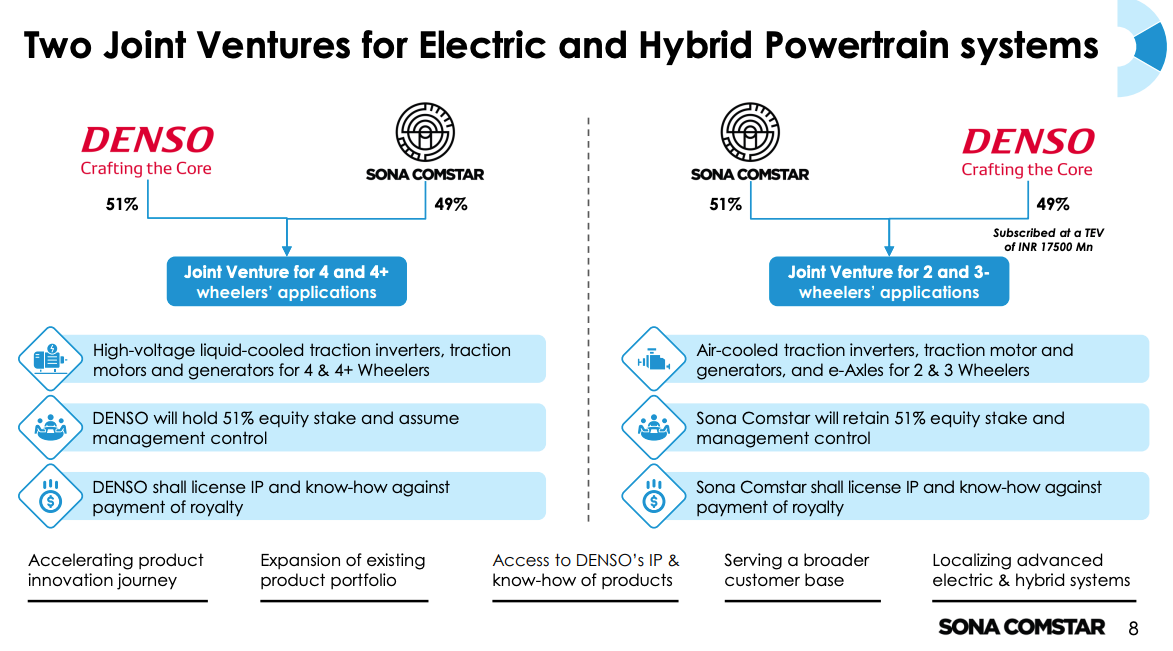
The mechanism is pretty much straightforward. Sona Comstar had no presence in high voltage electric or hybrid powertrains for passenger and commercial vehicles. DENSO brings that capability. DENSO’s electrification business revenue exceeds $8 billion annually, and it is described by management as the runaway leader in hybrid powertrains. Sona Comstar brings its frugal motor design and manufacturing strength in two- and three-wheelers, where it already holds a leadership position in India. The royalty structure is reciprocal: JV2 pays royalties to DENSO for high voltage technologies, while JV1 pays royalties to Sona Comstar for its two- and three-wheeler technologies.
“I suspect we may be the first Indian automotive company to receive royalty income from one of the global mobility technology companies.”
MD and Group CEO, Q1 FY27 concall (July 2026)
Management cited S&P Global Mobility data sizing the Indian hybrid and EV car and commercial vehicle market at over 2.3 million vehicles, representing roughly a INR 24,000 crore opportunity in 2030, growing to many times that by 2035. Phase I targets India, with Phase II intended for global expansion. The suspension motor business and all non-traction motor businesses remain outside the scope of both JVs.
On timeline, management stated that JV1 will kickstart faster, with JV2 following it. Specific SOP timelines are restricted by confidentiality agreements involving DENSO and customers. On capex intensity, management indicated that for every INR 1 crore of capex, high voltage systems can generate INR 11-12 crore of revenue, compared to INR 8-9 crore for two-wheeler motors, making this an engineering-intensive rather than capital-intensive business.
“We begin with India, and then we look at the world. Phase I is to get this up and running, then get Indian customers, start satisfying that, and then in phase II we would also look at that.”
MD and Group CEO, Q1 FY27 concall (July 2026)
The competitive landscape also matters. Management characterized the two- and three-wheeler space as far more competitive, while high voltage technology carries a higher barrier. DENSO’s controller and inverter portfolio fills a gap in Sona Comstar’s offerings, and the JV can sell to OEMs directly, to tier-1 e-Axle makers, or to Sona Comstar’s own driveline division for integrated e-Axle assembly.
Robotics and Physical AI - INR 8 billion order book secured across 3 orders (advanced robotic subsystem, perception engineering services for AMRs, short-range radar perception solution for Indian CV OEM)
Sona Comstar has formally entered robotics and physical AI as its third growth engine, positioning it alongside electrification and new product verticals. The thesis rests on technology convergence: the same building blocks that power electric and autonomous vehicles - motors, gearboxes, actuators, sensors, and embedded software - are the core components of intelligent machines, from autonomous mobile robots (AMRs) to humanoids. Management cited Morgan Stanley’s “Robot Almanac” research, which projects the global market for radars, reducers, and electric motors could reach approximately $60 billion, $1.4 trillion, and $2.5 trillion respectively over the next 25 years.
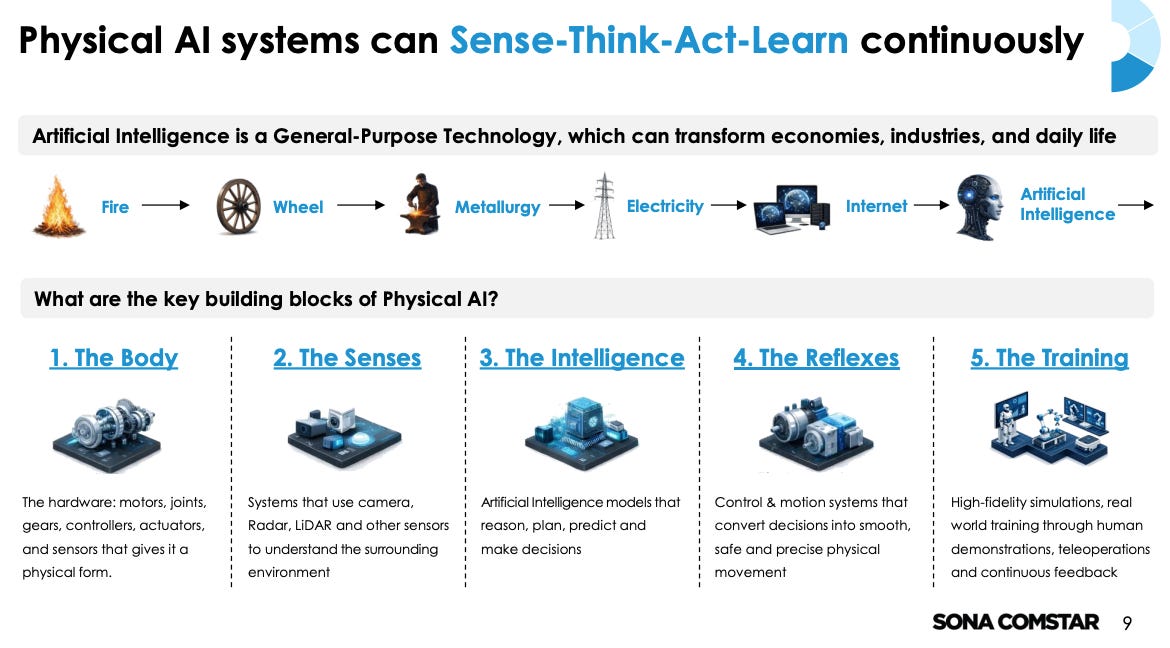
The company has structured its robotics business into three revenue streams. The first is advanced components and subsystems, drawing on existing capabilities in motors, gearboxes, and sensors. The second is perception stacks and engineering services, where Sona Comstar develops perception software and integrated hardware-software solutions for customers. The third is full robotic platforms, initially focused on AMRs and cognitive collaborative robots (cobots). The company showcased a prototype AMR at CES 2026 in Las Vegas.
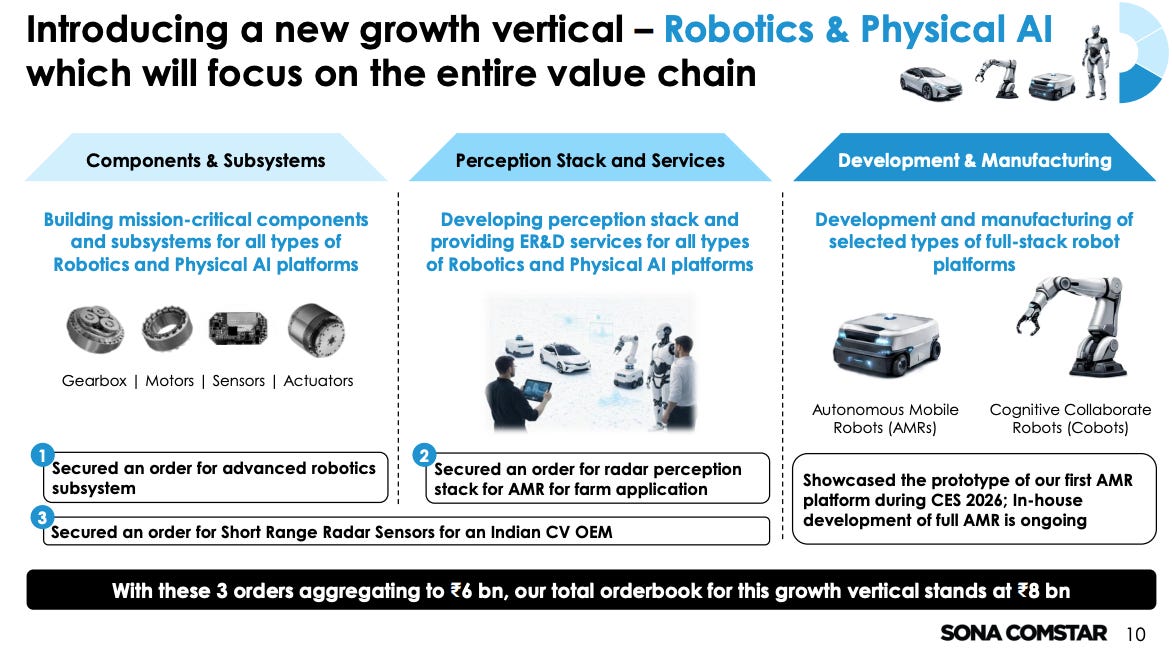
As of Q1 FY27, Sona Comstar has secured three specific orders. The first is for an advanced robotic subsystem. The second is for perception engineering services for AMRs, where Sona provides the entire perception software stack without building the physical machine. The third combines hardware and software - a complete short-range radar perception solution for an Indian commercial vehicle OEM, designed to meet upcoming government ADAS regulations.
“Together, these three orders, they add INR 6 billion to our robotics and physical AI order book, which takes the total order book for this new vertical to INR 8 billion.”
MD and Group CEO, Q1 FY27 concall (Jul 2026)
The INR 8 billion order book represents approximately 3% of the company’s total net order book of INR 240 billion. Management indicated the three orders have staggered start-of-production timelines: one begins in the current quarter, one in the following quarter, and the third within 15 months. This is a notably faster ramp than Sona Comstar’s historical new product cycle, where suspension motors took roughly four years from first order in 2021 to meaningful revenue in 2026.
Vivek Vikram Singh framed the acceleration explicitly: “this market may be developing far faster than we had originally anticipated.” He also indicated the robotics vertical’s revenue trajectory could be faster than the company’s typical 0-to-5-year cycle for new products to generate meaningful revenue, citing both internal development speed and market evolution as surprises.
The MoU with Neura Robotics of Germany, signed in FY26, provides the collaborative framework for industrializing robots, cobots, and humanoids in India and other markets. The annual report confirms the AMR platform demonstrated at CES 2026 integrates capabilities across Sona Comstar’s motor, driveline, and sensor divisions, while establishing new expertise in robot perception, motion planning, telematics, reinforcement learning, and AI orchestration.
European supply chain realignment - 3 direct competitors filed for insolvency; ~400-500 million euros of revenue potentially redistributable
Three of Sona Comstar’s direct competitors in Europe - all driveline players making differential gears and differential assemblies - filed for insolvency proceedings during FY26. One has been adjudicated for liquidation, another is heading the same way, and the third’s outcome remains uncertain. Management first flagged this in Q2 FY26 (Oct 2025) and has tracked it through Q1 FY27.
The mechanism is straightforward. When a supplier files for insolvency, OEMs move urgently to resource those parts. Sona Comstar is already a proven, scaled supplier of the exact same products to many of the same customers. The customers do not need to qualify a new vendor from scratch - they are resourcing to someone they already know. Vivek Vikram Singh described this as a “hardcore urgency” driven by financial imperative rather than the softer “China plus one” narrative that never fully materialized in 2022-2023.
“about 400 million to 500 million euros worth of revenue companies might just fold, and all that they do will have to be redistributed across the supply chain.”
MD, Q3 FY26 concall (Jan 2026)
By Q3 FY26, roughly one-third of Sona Comstar’s RFQ pipeline - which management said was the strongest in company history and nearly 3x the prior year - was coming from European customers. Singh specified that these opportunities sit at stage 3 or 4 of the pipeline, meaning product samples are already approved and the conversations have moved to commercial negotiations. Some conversions may have already happened during Q3 itself.
The first tangible evidence appeared in Q4 FY26 (May 2026), when Sona Comstar won 3 driveline orders from European OEMs in a single quarter - the highest ever from Europe, and the first EV order win from the continent in nearly 4 years. These included a new European customer for differential gears, a differential assembly order from a luxury PV OEM, and a hybrid differential assembly order from an existing European OEM. When asked about the insolvency situation on the Q4 call, Singh confirmed that “some of that has already started flowing in” while noting the opportunity set remains open over the next 12 months.
On margins, Singh stated in Q3 that most of these resourcing opportunities are actually higher margin than the company average, because they tend to involve larger vehicles - SUVs, pickup trucks, commercial vehicles - where torque requirements and value addition per unit are higher.
Suspension motor business ramp-up with new customer models and cross-sell to European OEMs
Sona Comstar’s suspension motor business supplies BLDC motors and motor controller-based actuators to ClearMotion, which integrates them into its predictive active suspension system. The system launched commercially on Nio’s premium EV models in China. Sona Comstar designs and manufactures the actuator, while ClearMotion sells the full suspension module to OEMs.
The first commercial model’s success has driven cross-sell. In Q2 FY26, management disclosed two additional nominations - one from an existing Asian EV OEM (Nio) for another model, and one from a new European luxury performance OEM. These two programs carry a lifetime order value of INR 8.2 billion and begin production in Q2 FY27.
“We have also been nominated for two more programs for our motors and motor controllers for the predictive active suspension systems.”
Management, Q2 FY26 concall (Oct 2025)
By Q4 FY26, the MD called suspension motors the fastest-growing business by far, with triple-digit growth expected. Sat Mohan Gupta, CEO of the Motor Business, confirmed the customer has launched a second premium model and volumes are running strong in both China and Europe.
“we are looking at a very high volume, as Vivek said, I mean, 3 to 4 times growth compared to last year... our end customer is working with other OEMs in Europe, and it is wide acceptability in the automotive sector.”
Sat Mohan Gupta, CEO Motor Business, Q4 FY26 concall (May 2026)
The MD added that suspension motor revenue is currently single-digit as a percentage of total revenue but could touch double digits next year, depending on how quickly ClearMotion wins additional OEM customers. The product is powertrain-agnostic - it works on ICE and EV platforms - but new vehicle launches where integration is easiest tend to be electric.
China was Sona Comstar’s fastest-growing geography in Q1 FY27 specifically because of the suspension motor ramp. The business remains entirely outside the DENSO joint venture scope, which covers only traction motors. This means all suspension motor economics stay with Sona Comstar directly. The cross-sell to a European luxury OEM is the first proof point that the technology can expand beyond its initial Chinese customer, which is the mechanism that turns a single-customer product into a multi-customer platform.
Mexico driveline plant - first order secured for differential assemblies to US recreational vehicle OEM (INR 2.6 billion)
Sona Comstar inaugurated its Mexico driveline plant in Silao in 2024, originally conceived to supply a large North American OEM customer. The plant manufactures bevel gears and differential assemblies, giving the company a manufacturing footprint inside the USMCA trade bloc. Vikram Verma, CEO of the Driveline Business, confirmed that the plant has since begun winning its own business independently, rather than simply absorbing work shifted from India.
In Q2 FY26, management announced the plant’s first independent order win: differential assemblies for a US recreational vehicle OEM, adding INR 2.6 billion to the order book. Production is scheduled to start in Q2 FY28.
“we’ve secured our first program for the new driveline plant in Mexico, from where we will supply differential assemblies to a recreational vehicle OEM in the US. This program has added 2.6 billion to our order book with production expected to start in the second quarter of FY 28.”
MD & Group CEO, Q2 FY26 concall (Oct 2025)
Vivek Vikram Singh framed the order as validation of the Mexico plant’s strategic logic. The customer had already shifted one program to Mexico from India at its own request, and this new order is a second program from the same OEM - an indication of repeat confidence. He also noted that the plant provides optionality: if tariff scenarios worsen, Sona Comstar can shift additional programs to Mexico without building greenfield capacity from scratch.
The mechanism is straightforward. Differential assemblies are the company’s highest-value driveline product, and Mexico-based production allows Sona Comstar to supply US OEMs under USMCA content rules, avoiding the 25% Section 232 tariff that applies to imports from India. Verma confirmed that the plant is seeing traction from multiple North American customers beyond this single order, though he did not quantify that pipeline. The INR 2.6 billion order represents lifetime revenue over the program’s run, and with SOP roughly two years away, revenue will begin flowing in FY28.
Railway business new products - HVAC, electric panels, air springs, automatic doors expanding addressable market
Sona Comstar acquired the Railway Business from Escorts Kubota on 1st June 2025. At the time of acquisition, the business supplied safety-critical brake systems, couplers, and suspension products to Indian Railways. Management’s stated plan from the first concall was to apply its “single-product to multi-product” playbook - the same approach used with Comstar (starter motors) and Novelic (radar sensors) - to expand the railway portfolio into passenger comfort and electronic systems.
The new products are HVAC systems, electric control panels, air springs, and automatic plug door systems for metro and semi-high-speed trains. The annual report confirms three were commercialised in FY 2026: hydraulic motor controller, railway HVAC systems, and railway electric panels. Air springs were added to the roadmap in Q3 FY26, and automatic doors are in development.
The mechanism is straightforward. Indian Railways is modernising its rolling stock across Vande Bharat, Amrit Bharat, and metro networks. Each new train platform requires higher component content per coach than legacy stock. By moving beyond brakes into HVAC, panels, air springs, and doors, Sona Comstar increases its share of the bill of materials on each coach. Amit Mishra, Head of Railway Business, quantified the market sizes on the Q4 FY26 concall:
“HVAC is about between 2,000 to 2,500 crore market size, and electric panel is also about 1,500 crore.”
Amit Mishra, Head of Railway Business (Q4 FY26 concall, May 2026)
These are addressable markets covering all rolling stock types - locomotives, passenger coaches, train sets, and metros. For context, the railway business order book at the end of Q2 FY26 was INR 13 billion, with execution expected within 12 months.
The timeline is staggered. Electric panels are further along in development. Mishra stated it will take 12 to 15 months to cover all types of rolling stock for electric panels, because development is more advanced. HVAC will take at least 3 years to cover all rolling stock segments, as approval cycles and field trials are longer. He was explicit that new products will become meaningful revenue drivers from the third year onward, with the next two years driven by operational improvements and filling white spaces in existing product lines.
The first batch of electric panels for locomotive applications has already been supplied. HVAC system supply was scheduled to begin in the quarter following the Q4 FY26 concall. On the Q3 FY26 concall in January 2026, Vivek Vikram Singh noted that air springs alone would “quadruple the addressable market for us in suspension systems” for rolling stock in India.
Management has also signalled intent to expand beyond Indian Railways. Mishra mentioned active work on increasing presence in the metro segment and selected export markets, though no export revenue has been disclosed yet.
ADAS radar sensor production at Chennai SMT facility for in-cabin and exterior applications
Sona Comstar’s Novelic subsidiary, acquired in 2023, has set up a surface mount technology (SMT) production line in Chennai to manufacture millimeter-wave radar sensors. These sensors serve two distinct applications: in-cabin radar for occupant detection, child presence detection, and driver monitoring systems, and exterior radar for blind spot detection, moving-off information systems, autonomous emergency braking, and lane departure warning.
The trigger mechanism is regulatory. The Government of India has notified ADAS implementation mandates for M2, M3, N2, and N3 class vehicles - medium and heavy commercial vehicles. Praveen Rao, Group CTO, confirmed on the Q3 FY26 concall that the in-cabin radar product has been augmented with a vision system to address mandates under AIS 184 regulation (DDAWS), and that the exterior radar solution offers a 180-degree field of view that can replace up to 12 traditional ultrasonic sensors and 4 corner radars with just 4 radar sensors. He positioned this as roughly half the cost of what OEMs spend today on ultrasonic plus corner radar setups.
On the in-cabin side, Sat Mohan Gupta, CEO of Motor Business, confirmed on the Q4 FY26 concall (May 2026) that the SMT line is set up and the launch process for the first customer has begun.
“for Novelic India, we have set up the entity in India and we have started the launch process for one of the customers. The SOP is going to be end of this year. The lines are already set up, because it’s a sensor assembly unit. So we have an SMT line in-house and we’ll be using that SMT line.”
Sat Mohan Gupta, CEO Motor Business, Q4 FY26 concall (May 2026)
Praveen Rao added on the same call that in-cabin radar is being industrialized for a passenger car application, while exterior radar is in an advanced development stage for Indian commercial vehicles to meet upcoming ADAS regulations. Vivek Vikram Singh noted that European in-cabin safety NCAP certification requirements, which were expected in 2026, have shifted to 2027, giving Sona Comstar additional runway.
The Q3 FY26 concall (Jan 2026) provided the most specific commercial detail. Praveen Rao stated that Sona Comstar is among the early companies to set up a radar production facility in India, and that production support for OEM programs can begin anytime FY27 onwards. The Q1 FY27 concall (Jul 2026) confirmed that short-range radar sensors are now under commercialization, with the exterior radar sensor developed for a leading commercial vehicle OEM designed to meet the upcoming Government of India ADAS regulations. The annual report FY 2026 listed sample production of in-cabin radar sensors at the Chennai SMT facility as a completed milestone.
EV traction motor expansion to 4-wheeler and commercial vehicle segments
Sona Comstar’s traction motor business currently serves electric two-wheelers and three-wheelers in India. The company has built a roughly 25% volume market share in that segment and has constructed manufacturing capacity of approximately one million electric motors. The next growth trigger is extending these motors into four-wheeler passenger vehicles and commercial vehicles, where the addressable market is materially larger because per-vehicle motor value rises non-linearly with power and voltage.
Management confirmed on the Q3 FY26 concall (January 2026) that this expansion is actively under development but has not yet reached the purchase order stage. When asked whether the four-wheeler motor work targets cars or commercial vehicles, the MD responded:
“For all segments, whatever they may be for 4 wheels and above. Hopefully, in 6-7 months time, we will have a meaningful update for you.”
MD, Q3 FY26 concall (January 2026)
He further clarified the sequencing logic: “we will start with 2 wheelers, then move on to 3 wheelers, and then the toughest to compete is in 4 wheelers. So we will go to it in the end when we are certain of the capability of our product.” He noted that three-wheeler programs have already begun contributing revenue and that the four-wheeler piece is “closer than one expected” (Q3 FY26 concall, January 2026).
The mechanism is straightforward. Sona Comstar designs and manufactures the traction motor and controller. As vehicle power requirements increase from a 5 kW two-wheeler motor to a 100-plus kW passenger vehicle motor, the revenue per unit scales up disproportionately. Management has cited S&P Global Mobility data estimating the Indian hybrid and EV car and commercial vehicle market at over 2.3 million vehicles by 2030, representing roughly INR 24,000 crore in addressable opportunity (Q1 FY27 concall, July 2026).
The DENSO joint venture, announced in July 2026, directly accelerates this trigger. JV1 focuses on high-voltage electric and hybrid powertrain systems for four-plus-wheel vehicles, with DENSO holding majority and contributing the technology. This fills the single gap in Sona Comstar’s electrification portfolio - high-voltage motors for passenger and commercial vehicles - where the company previously had no presence. Management indicated that the capex intensity is low: for every INR 1 crore of capex, high-voltage systems can generate INR 11-12 crore of revenue, compared to INR 8-9 crore for two-wheeler motors (Q1 FY27 concall, July 2026). The first JV is expected to kickstart faster than the second, though specific SOP timelines remain undisclosed due to confidentiality agreements.
The traction motor business is already the company’s fastest or second-fastest growing product line. BEV revenue grew 107% year-on-year to INR 436 crore in Q1 FY27, reaching 44% of automotive product sales (Q1 FY27 concall, July 2026). Traction motor volumes are scaling on existing two-wheeler and three-wheeler programs before the four-wheeler expansion adds a second layer of growth.
Key risks
Commodity price inflation and pass-through lag. Steel, aluminum, copper, freight, packaging, and energy prices moved up sharply through FY26, amplified by the Strait of Hormuz crisis. While most commodity costs are contractually pass-through, the lag between input price increases and customer recoveries - plus the arithmetic effect of higher costs flowing through both numerator and denominator - depresses EBITDA margin as a percentage even when absolute EBITDA grows. Management cited this as the primary driver of the Q1 FY27 margin compression to 23.1%, with roughly half of the 80 bps Q4 FY26 margin impact attributable to commodity lag and half to product mix. The CFO noted that in any commodity inflationary cycle, percentage margins will take a dip until prices stabilize.
Rare earth magnet supply disruption. China halted supply of heavy rare earth magnets to India on April 8, 2025, and the restriction remained in place through Q1 FY27 - five quarters running. Sona Comstar shifted all motor production to light rare earth alternatives and developed a ferrite-assisted synchronous reluctance motor for three-wheelers and light commercial vehicles. This works for motors below 10-15 kW, which covers most of the two-wheeler and three-wheeler portfolio. Bigger motors above 15 kW remain challenging because the physics of power density at higher output is harder to solve without heavy rare earth magnets. If light rare earth supplies are also restricted - and both HRE and LRE sources are in China - the traction motor business, which is the fastest-growing segment, would face a structural constraint.
US tariff uncertainty and demand destruction. Section 232 tariffs at 25% on auto and auto components remained in place throughout FY26. While Sona Comstar’s revenue from the US did not materially decline - because tariffs are paid by importers, not exporters, and the company’s pricing remains competitive relative to Chinese alternatives - the inflationary nature of tariffs has reduced total US light vehicle demand by approximately 1 million cars. That demand destruction affects every supplier to the US market. The USMCA tariff relief was extended for five years to medium and heavy-duty vehicles, which helps, but the underlying demand impact persists.
Customer concentration and single-model decline. One large EV customer’s model decline created an approximately INR 300 crore revenue hole in FY26. The company has diversified significantly - top 5 customer concentration dropped from 62% in FY22 to 51% in Q2 FY26, and the largest customer’s contribution fell from 23% to 6% - but 51% concentration in the top 5 still means a single model cancellation or platform delay from any major customer can create a material revenue gap. The order book correction of INR 36 billion in Q2 FY26, driven by low-visibility programs, demonstrated this risk materially.
Product mix dilution from lower-margin segments. Traction motors and railway assemblies carry lower gross margins than the core precision-forged driveline business. As traction motor revenue grows - it was nearly 10% of revenue and growing at high double-digit rates - and as the railway business contributes 18-20% of consolidated revenue at roughly 18% EBITDA margins, the blended margin naturally compresses. Management guided to a 23-25% EBITDA band post-railway acquisition, down from the pre-acquisition 24-26% band. The VA-to-employee-cost ratio has declined because assembly businesses have higher material costs and lower value addition per employee than forging.
Haryana minimum wage increase and new labor code. The Haryana government raised minimum wages effective April 1, 2026. The new labor code, notified effective November 21, 2025, imposed a one-time INR 30 crore impact on PAT in Q3 FY26 from additional gratuity and leave encashment provisions. The recurring annual impact is estimated at approximately INR 4 crore. While small relative to the INR 670 crore adjusted PAT, it adds to the cost pressure alongside commodity inflation.
Gas availability and energy infrastructure. Gas availability has been a persistent challenge. The company mitigated by shifting to electric heating and optimizing gas flows, reducing gas requirements by approximately 20% at the company level. No production losses occurred, but the constraint highlights dependence on energy infrastructure that is outside the company’s control.
Geopolitical and trade uncertainty. Trade policies, tariff actions, protectionist measures, logistics disruptions, and cross-border trade rule changes could adversely affect customer demand, supply chains, costs, and overall business performance. The China JV with JNT was put in abeyance due to geopolitical factors. The Strait of Hormuz crisis drove oil and petrochemical-linked costs higher. These are structural risks for a company with 49% of revenue from exports across North America, Europe, and China.
Execution risk on new platforms. The DENSO joint venture, robotics and physical AI, railway new products (HVAC, electric panels, air springs, automatic doors), ADAS radar sensors, and the Mexico driveline plant all require simultaneous execution capacity. Management’s own framework is that new products take 0-3 years of investment before any revenue, year 4 for first revenue, and years 5-10 for material scale. The suspension motor took five years from order win in 2021 to meaningful revenue in 2026. The robotics order book of INR 8 billion has SOPs ranging from the current quarter to 15 months, but the category is nascent and model life cycles are uncertain.
Scenarios
Bull case
Three direct European competitors filed for insolvency during FY26, representing 400-500 million euros of redistributable revenue. Sona Comstar’s RFQ pipeline is three times the prior year, with one-third coming from European customers. The company has already won its first European EV driveline order in four years and three driveline orders from European OEMs in a single quarter.
If these conversions accelerate over the next 12 months as expected, the driveline business - already the highest-margin segment with 8.7% global market share in differential gears - could gain 200-300 basis points of share in Europe and North America. The DENSO joint venture opens the high-voltage electric and hybrid powertrain market for four-plus-wheel vehicles, an addressable market of over 2.3 million vehicles in India alone by 2030, roughly a INR 24,000 crore opportunity.
The royalty structure - where JV1 pays royalties to Sona Comstar for its two-wheeler and three-wheeler traction motor technology - validates the company’s IP at a global level. Meanwhile, suspension motors are tracking toward 3-4x growth, potentially reaching double-digit revenue share. The robotics and physical AI vertical has INR 8 billion in orders with SOPs starting within the current quarter, and management indicated the market is developing faster than internal assumptions. India’s EV two-wheeler and three-wheeler penetration is accelerating, with traction motor programs ramping ahead of expectations.
The Mexico plant secured its first INR 2.6 billion order, and railway new products - HVAC in a INR 2,000-2,500 crore market and electric panels in a INR 1,500 crore market - are entering commercialization. If the order book converts at historical rates and new platforms scale on the typical 5-year curve, Sona Comstar could compound revenue at 20-25% with margins stabilizing in the upper half of the 23-25% band as European driveline share gains and suspension motor scale offset the mix drag from traction motors and railways.
Base case
The INR 240 billion order book converts steadily, driven by the 67 EV programs across 35 customers and the railway order book of INR 13 billion executable within 12 months. BEV revenue continues to recover from the FY26 trough, reaching 40-45% of automotive revenue as US EV demand stabilizes and Europe and India accelerate.
Traction motors grow at high double-digit rates but remain the lowest-margin product, creating a 50-100 bps annual margin drag that is partially offset by cost reduction in the core forging business - die life improvements, material optimization, and the shift to electric heating.
The DENSO JV begins contributing in Phase 1 (India market) within 24-30 months, with Phase 2 (global expansion) following later. Suspension motors reach high single-digit revenue share by FY28. Railway revenue grows at 10-15% annually, driven by existing brake system demand and new product approvals (HVAC takes 3 years to cover all rolling stock segments, electric panels take 12-15 months). Robotics contributes INR 8 billion in revenue over 12-15 months from the current order book but remains below 5% of total revenue for the next 3 years.
The European supply chain realignment delivers INR 200-300 crore of incremental annual revenue as stage 3-4 pipeline opportunities convert. India remains the largest market at 50-55% of revenue, with eastern markets at 55-60%. EBITDA margin stays in the 23-25% band, with commodity pass-through lags and product mix roughly offsetting operating leverage gains. Free cash flow generation remains strong at INR 250-350 crore annually after capex of INR 350-450 crore, supporting organic investment and selective M&A.
Bear case
The US EV market fails to recover, with Section 232 tariffs keeping vehicle prices elevated and demand depressed. The 1 million car demand destruction becomes permanent rather than cyclical. European OEMs, under cost pressure from Chinese EV imports and energy costs, delay or cancel program SOPs, slowing the conversion of the INR 240 billion order book.
The large European EV customer whose model decline created the INR 300 crore revenue hole in FY26 does not recover, and the order book requires another downward revision. China restricts light rare earth magnets in addition to heavy rare earths, crippling traction motor production - the fastest-growing segment.
The ferrite-assisted synchronous reluctance motor cannot match performance at higher power levels, limiting the company to sub-15 kW applications while competitors with alternative magnet supply chains capture the growing three-wheeler and LCV market. The DENSO JV faces execution delays due to technology transfer complexity and customer validation cycles, pushing meaningful revenue contribution beyond year 3.
Railway new products face RDSO approval delays, and the HVAC market takes longer than 3 years to cover all rolling stock segments. Commodity inflation persists as the Strait of Hormuz crisis extends, and the Haryana wage increase compounds with the labor code recurring impact. Product mix deterioration accelerates as low-margin traction motors and railway assemblies grow faster than the core driveline business, pushing EBITDA margin toward the lower end of the 23-25% band or below.
The robotics and physical AI vertical burns capital for 3-5 years before generating meaningful revenue, and the AMR market develops slower than management’s revised expectations. The China JV remains in abeyance indefinitely, locking Sona Comstar out of the world’s largest EV market - 11 million units annually, two-thirds of global EV sales.
Valuation Model
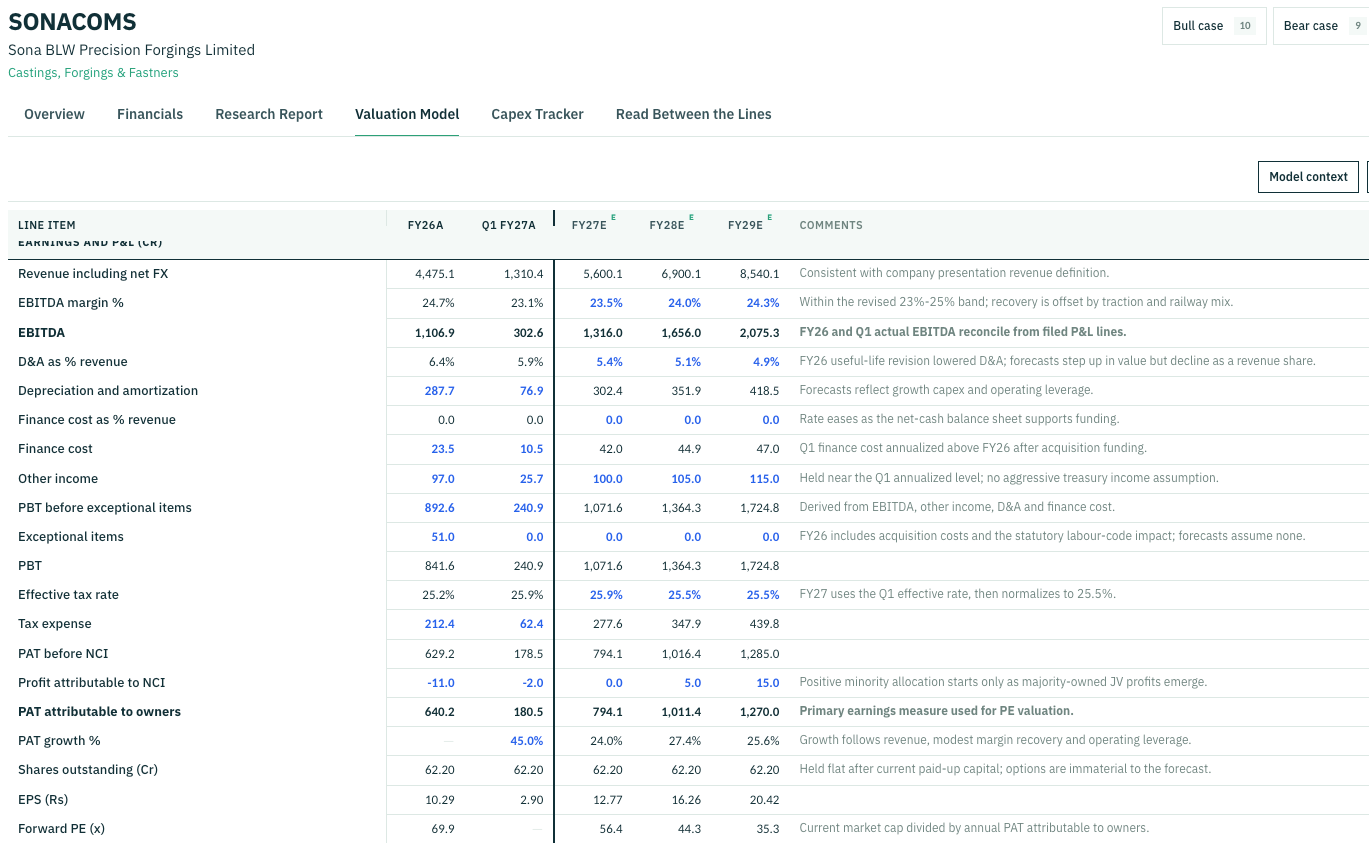
Thanks for reading! Do check out Investorstack